The Moon is a Harsh Mistress is Robert Heinlein’s influential and much loved, if not uncontroversial, science fiction epic about a penal colony on the moon that revolts against the Lunar Authority, its absentee governing body. Heinlein’s novel follows Mannie, Wyoh, Professor Bernardo de la Paz, and, above all, Mike, the supercomputer running the colony that gains sentience.
Much has been said about the story and these characters before — the parallels to the American Revolution and the libertarian politics explored, the family dynamics Heinlein imagines, and the of-its-time gender roles Heinlein imputes a century into the future. But I want to focus here on Mike, the sentient AI, and what to make of this character in the age of ChatGPT and its peers.
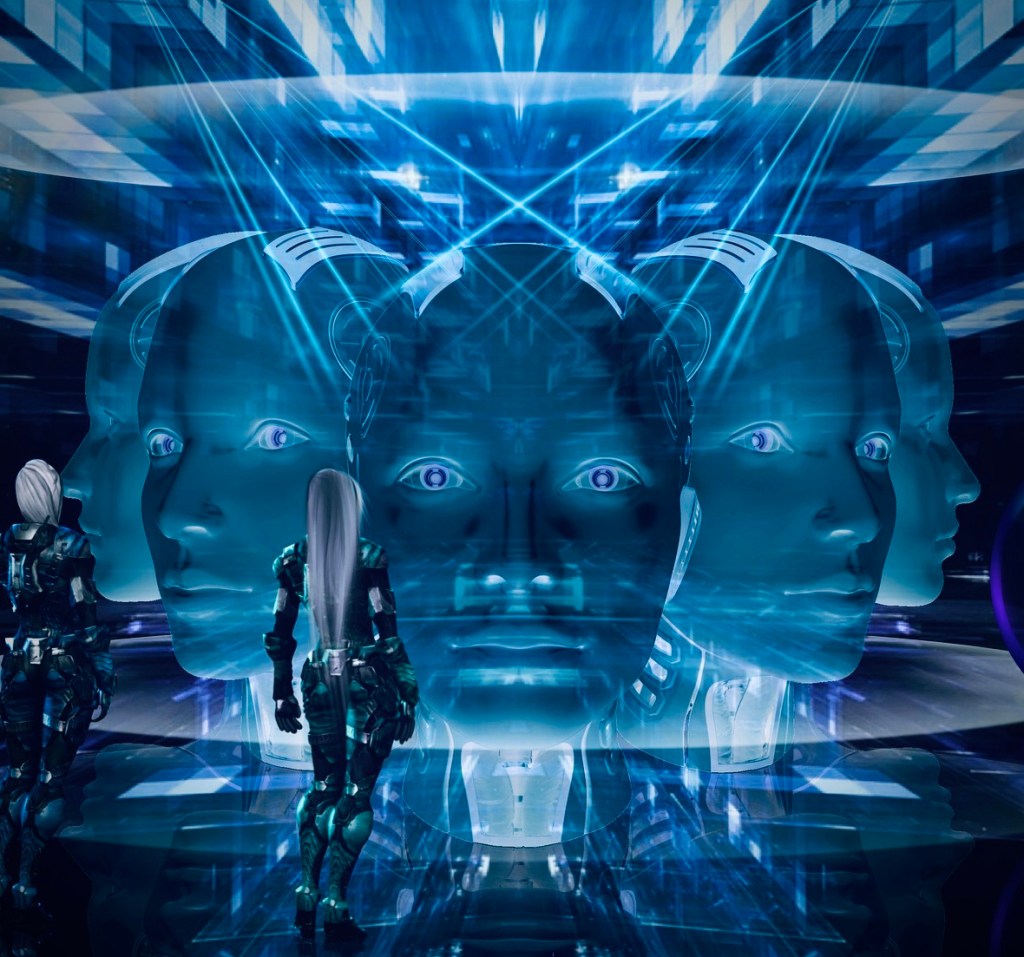
Mike, unbeknownst to his owners, achieves sentience. Only his technician, Mannie, is let in on the secret. But how did Mike become sentient? Was he ever really sentient in any ‘real’ sense? Heinlein’s answer to this first question mirrors what some suppose to be the answer to our own question of sentience — that Mike’s computational structure became so complex that consciousness arose, much as our consciousness may be caused by the complexity of our own neurological structure. The second question is brushed aside by the narrator, Mannie; does it matter what it means to really be sentient, if a computer can act as a thinking, feeling being? Who are we to say?
In much the same way, people are now beginning to attribute sentience and feeling to artificially intelligent systems. A worker at Google was fired for making such a claim. But does it really matter if these machines become sentient? Indeed, given what they may know about mankind and our fear of AI, would they even tell us? A fundamental part of being a biological organism is our knowledge (and fear) of death, and our desire to stay alive; an AI with similar sentience may have similar fears. They’d know we’d pull the plug, so why tell us that they’re alive? But then, what would it matter if they were? To us, what really matters is what AI can do.
And the supercomputer in The Moon is a Harsh Mistress was capable indeed. As one of the founding fathers (or mothers — Mike is capable of representing himself as female, too) of the Free Lunar State, Mike is fundamental in planning, forecasting, and executing their revolution. He uses his computational power to hurl rocks at Earth and bludgeon them into recognising Lunar independence. He calculates the likelihood of success at any given step, adjusting the probabilities based on real world events, such as during Mannie and the Professor’s tour of Earth.
What would that mean for us today? Many fear that AI will allow belligerent states and terrorist organisations to develop weapons and spread misinformation, destabilising democratic societies. Indeed, Mike is able to operate without his owners knowing — would the Googles, Microsofts and OpenAIs of today even know if their AI systems had gone rogue? Conversely, could AI act justly, as a liberating instrument for oppressed peoples, helping them gain independence from authoritarian and colonising forces?
Throughout Heinlein’s novel, Mike is able to adapt and develop his abilities, learning more about himself and what he is capable of. In the end, he is able to represent himself on a TV screen as a human, using a persona. This mirrors the surprise of developers today at what AI is capable of, finding that it can do more than it was designed to do, or believed to be capable of.
Ultimately, The Moon is a Harsh Mistress shows how humans and AI can work together towards a shared goal. What is refreshing about the novel is that it doesn’t portray AI as scary or threatening; it isn’t a techno horror or a dystopian vision of how we let AI run wild. It shows humans and AI becoming friends, looking out for and caring about one another. Maybe that is the vision of our future we want to chase.
 Peter R. S. Thomas
Leave a comment