Tag: writing

  • Flash Fiction: Infinite Reruns

    Flash Fiction: Infinite Reruns

    About this post

    This is the result of a writing exercise. The goal is to come up with something short and focused without spending too much time editing and revising. It might read a little raw and unpolished, but that’s the nature of the beast! With this piece, I was trying to find a particular character voice, something a little chaotic and irreverent. I settled on something to do with time travel to raise the stakes a little and play around with a few ideas there, too.

    The hands on the clock just wouldn’t stop turning. I sat there for hours, watching, trying to make them stop.

    I know it was hours because I was sat watching a clock.

    The thing no one ever tells you about time control is how long it takes to figure out how to do it.

    But when I cracked it, oh boy. You better believe I did some heinous shit.

    It all started when the minute hand went backwards.

    That was when I first knew I could control time.

    You see, time moves like water. It’s fluid. It fills up whatever container you put it in. And once you figure that out, you’re in control. Have you ever poured water from one glass to another? Well, that’s me, but with the fourth dimension.

    A river doesn’t go in a straight line, and neither does time. It curves and bends and goes back on itself. And sure, if you leave a river alone it’ll forge its own path. But I’m the guy who comes in with a construction crew and digs a canal.

    The first thing I did when I found out I could control time was go back and win an argument with my dentist from 2003. Not even an important argument.

    Well, it was important to me.

    She said I should floss more and I said I flossed plenty. This was a lie. But I’ll be damned if I let her be right about it. So I went back, flossed for three months straight, then returned to that appointment just to prove a point. She didn’t notice. Just said the same damn thing.

    Dentists…

    The second thing I did was become president of the United States of America. Let me tell you how I did it.

    It was pretty simple, really.

    So, the thing is, I still age, but only linearly. I can’t go back further back than when I was born, and I can’t go further forward than when I’ll die (I tried once to push past it and I did not like when I saw).

    But I can do what I want in the middle. Go back and forth as much as I like and change what I want. I’m just the age I am at that point in time.

    This 76 year period is mine to do what I like with. Cool, right?

    Okay, now, take your mind back to probability class. Random variations in how shit works out mean that anything can happen. Monkeys and typewriters and whatever.

    You put your name on the ballot box, do nothing else, maybe a couple of people tick it by accident. No big deal. The odds of a couple people ticking your name are good. Enough to win the presidency, pretty slim.

    But the odds are there. And I’m fluid like water, baby, I’ve got infinite reruns.

    Took me a little over 847,000 tries total. Election day 2016 (come on, you know why I picked that one).

    I voted for myself and went home. Lost. Rewound. Voted for myself and went home. Lost.

    You get the idea. Around try 31,000 I got bored and started seeing how many hot dogs I could eat while waiting for the results. Personal record is 23, in case you’re wondering.

    By try 400,000 I’d memorised all the lottery numbers and had myself a little splurge. By around 700,000 I was going insane. But on try 847,356? I won. By four votes. In Wyoming, of all places.

    So the universe blinked first, and now I’ve got the nuclear codes. Which… brings me to the third thing I did.

    Have you ever launched a nuclear bomb? I wouldn’t recommend it.

    I was destined to live until 76, that much I knew. But I could sure as hell die before that.

    So, yeah, it was me. I turned the world into a post apocalyptic hellscape.

    No big deal, right? Wrong.

    Whatever the fuck mutation meant that I could change time was shattered by the radiation from the nuclear fallout.

    Fuck me, right?

    I spent a while fussing with clocks. Started by turning the minute hand back with my finger.

    It made the clocks show a different time. But it didn’t do a damn thing about where I sat on the continuum.

    I was stuck moving in one direction at the same speed as everyone else.

    Why did I even do it? I know what you’re thinking.

    China.

    Russia.

    North Korea.

    Wrong. Wrong. Wrong.

    You’re stumped. Was it France?

    No, you idiot. Don’t you get it? I was bored. The world is my plaything.

    Infinite. Fucking. Reruns.

    Well, not anymore.

    Now, I’m just like everyone else. At least, everyone who survived the nuclear holocaust. Which isn’t that many. (Being president nets you a few perks, not least having a nuclear bunker.)

    And yeah, sure, I shouldn’t have left the bunker. But I was curious. And let me remind you: I didn’t know that the radiation would cook the one interesting thing about me!

    So I get up each morning, if I make it through the night, and try to survive. It was months of eating mutated pork chips and drinking irradiated water.

    Until the unthinkable happened. My body started to mutate again. I got that familiar pull, like when you take the plug from a bath tub.

    Except here I’d be pulling the plug from a dam.

    After all those months, I knew deep down I could go back.

    But I also knew that it would kill me to do it. One last jump, one last reset, take everything back to how it was.

    How did I know? I just knew. It’s that same sinking feeling you get like when the cops show up at your door. You just know it’s bad news.

    Fuck me, I’m a coward. Every day I don’t do it, is a day I could get my head bitten off by some mutated creature that would make those fucked up fish in the Mariana Trench blush. And with me goes humanity’s last chance at survival.

    But if I do it, I’m gone. Permanently. And so what would it matter if I got things how they were if I couldn’t be there to enjoy it?

    So, yeah… Here I am. Sorry, not sorry, I guess.

  • Book Review: The Restaurant at the End of the Universe

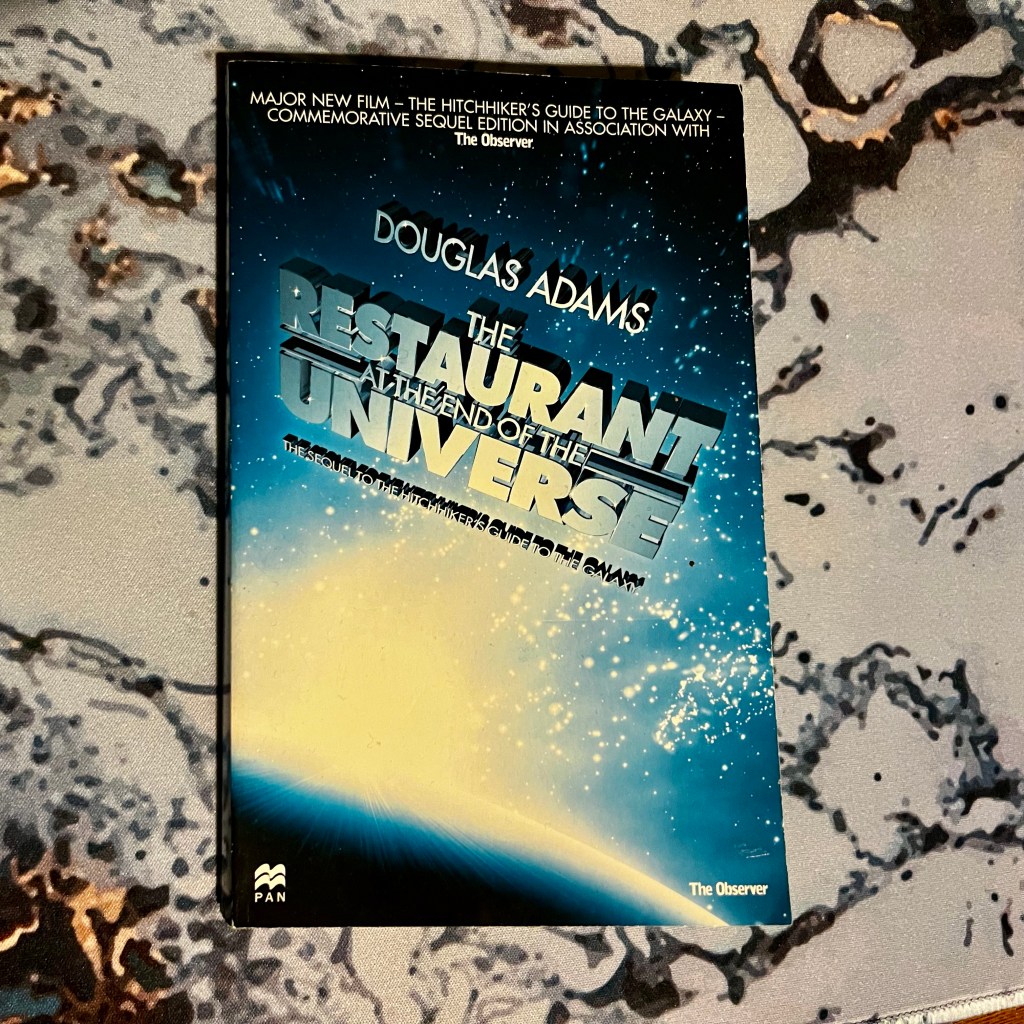
    Book Review: The Restaurant at the End of the Universe

    The Restaurant at the End of the Universe by Douglas Adams is full of the same zany, unpredictable storytelling that made The Hitchhiker’s Guide to the Galaxy such a hit. 

    What I love most about this book is how the book jumps from one impossible situation to another. I had no idea where the story was going to go, and neither did the characters. This is made possible by the technology within Adams’ universe, whether it be teleportation, time travel, or reality manipulation. I think the thing that makes it work as a narrative device is that the stupid, unpredictable situation the characters find themselves in always makes things harder, or worse; they might be rescued from one situation, but find themselves jumping out of the frying pan into the fire. This makes it really effective storytelling.

    I think the character work wasn’t as strong as the preceding novel. Marvin remains one of the best characters in modern literature, and I really enjoyed having large chunks of the story told from Zaphod’s perspective. His journey to meet the ruler of the universe revealed some great backstory. But Arthur, Ford, and Trillian’s storylines were undeveloped and not quite as interesting by comparison.

    The ending was a little flat for me, as well. Zaphod finally meets the ruler of the universe and, [SPOILERS], it turns out he doesn’t have any idea that he’s making decisions that impact the entire universe (a universe the ruler isn’t sure exists). I get the joke Adams is making, but the execution, especially how quickly Zarniworp becomes frustrated, didn’t hit for me. Similarly, Arthur and Ford wandering around prehistoric Earth was a bit of a drag. That said, the revelation of the Ultimate Question was exactly the kind of comic deflation that worked really well.

    I’ve been reading a lot of Terry Pratchett and Douglas Adams recently. I’m still at the starting point of my journey through their respective universes, but I’m finding myself preferring Adams’ humour and writing style at the moment (though don’t get my wrong, both are fantastic). Where Pratchett sometimes breaks the fourth wall with references to our world, Adams creates alien societies that mirror our own absurdities without winking directly at the reader. This makes the satire feel more integrated and immersive.

    So, onwards I journey! Next stop: Life, the Universe and Everything.

  • Book Review: The Summer Tree

    Book Review: The Summer Tree

    Content Warning: This review discusses a book containing sexual assault.

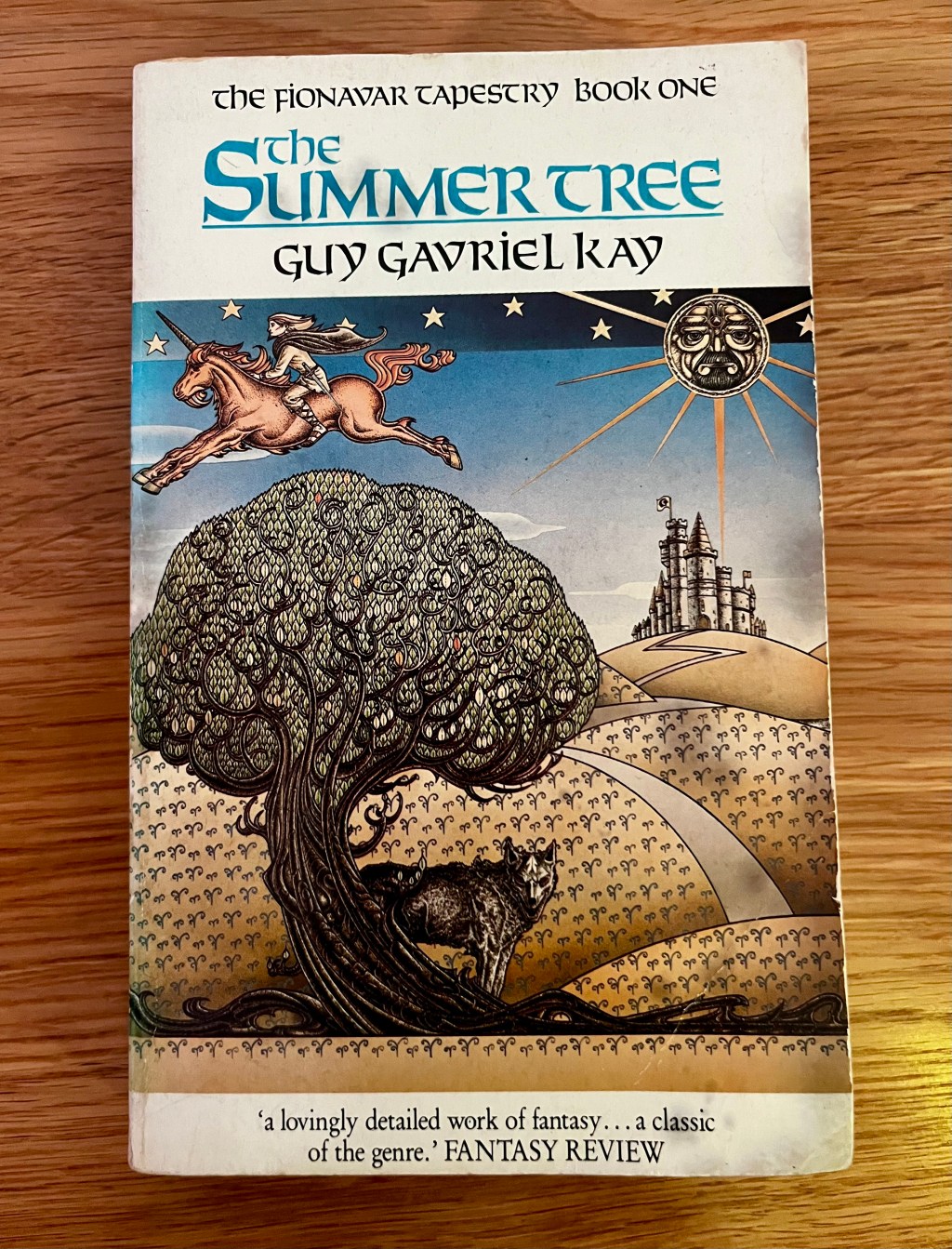
    The Summer Tree, a richly imagined fantasy adventure, is the first of Guy Gavriel Kay’s Fionavar Tapestry trilogy. The novel follows five university students from Toronto who are transported to Fionavar, the ‘first of all worlds’, where they become entangled in an ancient conflict against a dark god breaking free from imprisonment.

    Kay’s worldbuilding is probably the highlight of the novel. The magic system, where mages must be tied to other individuals who serve as ‘sources’ of power, is a nice mechanic. Also nicely done is the imprisonment of dark god Rakoth Maugrim beneath a mountain. The mountain looms visibly in the landscape as a prison in plain sight of all who live there. And the ritual of the Summer Tree itself introduces a compelling concept: kings are traditionally expected to sacrifice themselves during times of crisis, offering their lives to the gods. But they can send others in their place, and this puts one of the protagonists in an interesting position. Throughout, the metaphor of a tapestry and a weaver (symbolising fate and determinism) is contrasted with the dark god—the ‘unweaver’.

    The narrative mostly focuses on its classical fantasy setting—think kings and castles and mages—but it takes a refreshing turn in the final third when we finally reconnect with Dave, the fifth member of the transported group, who went missing during the journey into Fionavar. Kay’s incorporation of Native American-inspired elements here adds a level of cultural diversity to what otherwise might have been a purely European-inspired fantasy setting. The pacing of the story is fine, and the prose is accessible throughout. There’s the odd name you have to remember, but you’re not drowned in unnecessarily complicated language.

    Of the ensemble cast, certain characters stand out with more memorable moments and clear arcs. Paul, driven by grief, finds his place on The Summer Tree; Kevin’s personality comes through. However, this is also where some of the novel’s weaknesses emerge. With five modern-day characters thrust into this fantasy realm, Kay effectively shows different reactions to this strange new world, but this breadth comes at the cost of depth for some characters. We get more substantive development for some protagonists, while others remain relatively undeveloped.

    This imbalance is particularly noticeable in the female characters, both from our world and Fionavar itself. Too often, women in the narrative exist primarily as romantic interests, objects of desire, or victims of violence. In the final pages, there is an instance of sexual assault—unnecessarily graphic as far as I was concerned—as a plot device to show how evil the dark god is. Reading this book forty years after it was first published, it certainly feels dated in this regard.

    Kay has earned comparisons to Tolkien, and not undeservedly so. His own work with Christopher Tolkien in drawing together the stories for the The Silmarillion undoubtedly impacted him, and he has brought to the genre a blend of different mythologies and influences. But I don’t think I was so enamoured by this book that I’d want to continue the trilogy.

  • Why Fantasy, Why Now

    Why Fantasy, Why Now

    The world is a little bit on fire right now. Climate change is getting worse. Politics have taken a shift to the right, threatening the rights of historically marginalised peoples. Technology is developing at a rapid pace—creatives are being displaced, jobs are under threat.

    In this world, Fantasy occupies a special place. It offers an escape, yes, but not just escapism—it’s a lens through which we can view and process our reality.

    Firstly, Fantasy gives us the freedom to isolate a problem and task a character with finding a solution. The problem can reflect something we face in our real world. In doing so, the reader is given the opportunity to consider the solution space. With our protagonists, we explore what the various options are.

    From Frodo in The Lord of the Rings to Vin in Mistborn, our heroes are challenged to take on evil and oppression. They try different ways to solve their problem. They fail, and get back up—this is what keeps them relatable, and the reader cheering them on—until they find something that works. 

    And it isn’t just about finding strength and power: Kvothe in The Name of the Wind shows us how intelligence and wit can be used to fight a struggle against poverty. We seem him struggle at numerous times, and we’re with him as he explores ways to attend the University, despite his background.

    In most stories, in the struggle between good and evil, good (usually) ends up on top. (Not always, but usually!) This gives us hope that the struggles we face will one day be resolved. We also learn the costs associated with different actions, the drawbacks, the mistakes—the things we may want to avoid rather than repeat. Through such works, we learn not just what to do, but what to avoid, and how to think critically about our own world’s challenges.

    Mistborn begins in a world where evil has already won, yet our heroes still find a path toward hope and redemption. Hope emerges here from a seemingly hopeless world. In contrast, Legends & Lattes reveals to us smaller victories, more personal, where an orc warrior who has tired of adventure can find fulfilment in opening a coffee shop (and in the relationships she forges along the way).

    A core aspect of Modern Fantasy is the exploration of oppression and difference, race and culture, sexuality and gender identity. Through Fantasy, people who may not have a voice in our world are given time to speak, to explore their concerns, to be heroes and represent the power to change. Above all, even though many of the creatures and peoples we encounter are not human, Fantasy helps us explore and understand our common humanity, our shared personhood and experience.

    Terry Pratchett’s Guards, Guards! and Men at Arms (and numerous other works, honestly, but I pick these as they’re fresh in my mind!) explores class discrimination and systematic inequality through the members of the City Watch. Here, peoples of different races and backgrounds and genders explore and overcome their differences in ways that are humorous, touching, and sincere. Similarly, the Edge Chronicles presents a world where many creatures (from Banderbears to Sky Pirates) must learn to coexist despite their differences.

    When the world around us gets too much, Fantasy allows us to disappear into a world unlike our own, full of mystery and adventure. But that does not mean we are running away. Like the heroes in our stories, we enter these worlds not to abandon reality, but to return changed and better equipped to face it. The best stories don’t just transport us: they transform us.

    Much of this is, of course, true of Science Fiction as well. Where Fantasy uses far off worlds and systems of magic to explore these issues, Sci-Fi uses far off futures and technological changes. Asimov’s Foundation series explores how civilisations can deal with large-scale crises; through Do Androids Dream of Electric Sheep? we question our humanity in a world of advancing technology; similar questions are raised in Asimov’s Baley—Olivaw series (my favourite being The Naked Sun) where the closing gap between robot and human, and the restructuring of human society around that, is explored.

    From finding solutions to considering mistakes, from giving marginalised peoples a voice to giving us the strength to face our world, literature is powerful. And it’s needed now, more than ever. So tell me, what about you? How have the stories you love changed you or given you strength?