Tag: world building

  • Flash Fiction: A Vision of What Might Have Been

    Flash Fiction: A Vision of What Might Have Been

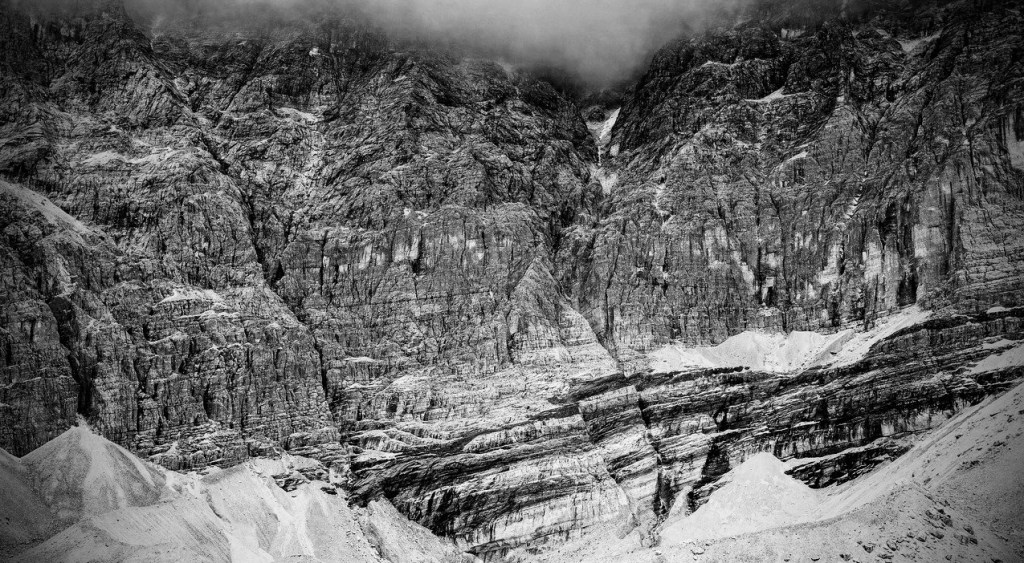
    There wasn’t always a castle on the hill. The seed was planted many years ago. A warc carried a stone, a vision of what might have been, and buried it six inches below the surface of the earth.

    The warc covered it with loose soil, its gritted, gnarled hands clawing desperately at the ground.

    A vision of what might have been.

    The castle grew over time, stones assembling themselves piece by piece, year on year. The locals in the village below watched with curiosity, waking every morning to see it risen slightly higher. None ever saw the workman. They went to bed and woke each morning feeling just a little safer.

    It was just what the warc had wanted. A gift for the village, unsolicited, but earned.

    The warc stepped backwards through time. The journey is linear, and to a creature that appears more branch and moss than flesh and bone, it is the correct and only direction.

    So to see what might have been is, for a warc, to see and anticipate the future.

    And the walk backwards, step by step, is, for those whose feet go against that flow, to see the future with utmost clarity.

    The villagers did not survive the strangers, who arrived one night carrying torches and flame, and put to waste thatch roofs and wooden walls. They took with them wheat and mutton and stores of fresh water. And carried on their quest.

    It was an important quest, of that they were certain, but the details matter not. To the villagers, the quest meant nothing; and yet they perished at its hand, and valiantly. They fought against the tide, with pitchforks and sharpened poles, but to no avail. They were swept out to a starless sea.

    The warc watched, and was moved by what it saw. And so it vowed to reward the villagers for their bravery. A stone was fashioned such that it would bless the village with strength and fortitude. A place for them to retreat.

    And so it was that the stone was planted.

    And, so it was, that a hundred years hence, in the deep past of the warc’s journey, as time flowed back against the grain of its footprints, the villagers retreated to the walls of this castle at the first sign of flame.

    And the thatch roofs burned, and the wheat and mutton was taken, but the villagers, brave as they were in that vision of what might have been, lived long enough to rebuild their homes and replenish their stocks.

    And they cursed the strangers who rode through their lands. But they knew not the vision of what might have been, for to them the castle had always been there, a steadfast relic of generations gone.

  • Book Review: The Dungeon Anarchist’s Cookbook

    Book Review: The Dungeon Anarchist’s Cookbook

    Downward to floor four! We join Carl, Princess Donut, and Katia in the Iron Tangle, an impossible and complicated subway system with thousands of intersecting railway lines. It’s like someone based it on a bowl of spaghetti they dropped on the floor. The routes are a claustrophobic mess, and the trains are, of course, full of monsters.

    Each book in this series finds a new way to frame the dungeon, and the Iron Tangle is one of Dinniman’s more ambitious settings. It’s also not my favourite. There’s an inherent constraint to a train-based floor that the previous book’s more open, expansive world didn’t have. It doesn’t give the characters as much room to manoeuvre.

    That said, this is an enjoyable read. The plot unfolds at a steady pace, with exciting set pieces and a central mystery that gradually reveals itself. In particular, we have ominous revelations about the Krakaren that feel like pieces of something much larger clicking into place. Of all the monsters, the mantaurs are a highlight. They’re physically odd, but it’s their Viking-esque obsession with dying gloriously in battle that gives them a layer of dark humour that stuck out to me.

    The titular cookbook is a clever device. Past crawlers passing their hard-won wisdom to Carl adds depth and intrigue. The talk show epilogues continue to be one of the series’ most distinctive features. They offer a way of stepping back from the dungeon action to reflect on what’s happened and seed what’s coming. It may feel like a bit exposition heavy to some, but it works for me.

    The characters remain the central draw to this series. A highlight here is Katia. Her doppelganger ability to reshape her body leads to some memorably creative (and gory) problem solving. It’s her stint as a makeshift cowcatcher on the front of a train that stands out. It’s just the right blend of seriousness and absurdity. The only shame is that Mordecai disappears for most of the book!

    The previous book has been my favourite of the series so far, but The Dungeon Anarchist’s Cookbook remains an entertaining instalment that keeps the larger story moving in an intriguing direction. Onwards to the next floor!

  • Book Review: Carl’s Doomsday Scenario

    Book Review: Carl’s Doomsday Scenario

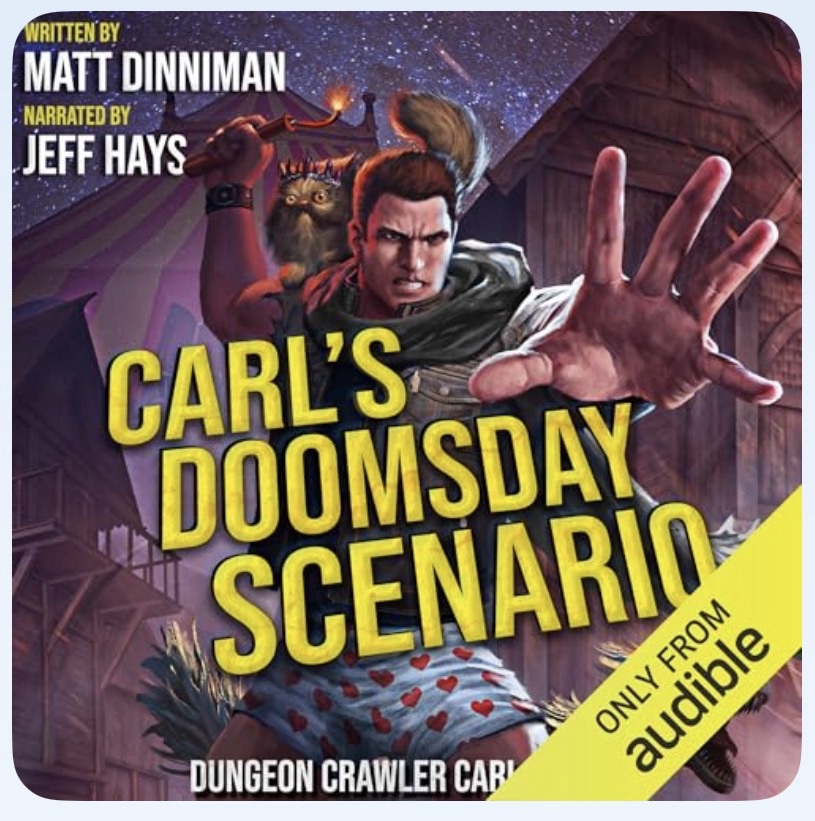
    And down we go to floor three with Carl and Princess Donut! This is where things get real…

    This is a great follow-up to Dungeon Crawler Carl that picks up right where we left off from book one. Earth has collapsed into an intergalactic dungeon crawl set up by extraterrestrial companies as part of some universe-wide capitalist hellscape.

    Safe to say, things are more dangerous, and just a tad complicated.

    If the first book was about establishing a world and proving its concept, Carl’s Doomsday Scenario is about deepening it. Dinniman writes well and with confidence, with characters you can’t help but fall deeper in love with.

    The heart of this book is the quest system. On floor three, crawlers have the option to engage in quests, which serve a quirky soap opera style addition to the crawl. NPCs have scripted storylines that run parallel to the activities of crawlers. This adds a new dimension to the world.

    As a narrative device, quests become a vehicle for exploring Carl’s empathy and fundamental decency. We see that his instinct, even in a system designed to brutalise, is to help people. And it’s through these moments that we get a window into Carl’s character. We get glimpses into his background and upbringing, which hints at something being built here for later in the series.

    Mongo, the velociraptor introduced at the tail end of book one, gets significantly more page time here, and I’m down for every minute. The creature brings out a new side to Princess Donut, a kind of maternal streak that adds warmth and depth. Mordecai, too, continues to grow into one of the most enjoyable characters in the series, with his wise and world-weary demeanor.

    The action is more intense and considerably gorier than the first book. Think Fallout’s VATS system with the gore setting turned on. Safe to say, Dinniman doesn’t hold back! But it’s not just all guns blazing action; solutions to problems feel creative, and give the book the same air of freedom you get when playing dungeons and dragons, where solutions are logical but often unexpected.

    The wider universe continues to expand in interesting ways too. The politics beyond the dungeon get murkier and more compelling, and the sense that Carl and Donut are pieces in a much larger game is growing.

    Carl’s Doomsday Scenario is an excellent sequel. It gives you what you loved from book one while raising the stakes and bringing in new elements. All the while, it still feels like the best is yet to come!

  • Book Review: Dungeon Crawler Carl

    Book Review: Dungeon Crawler Carl

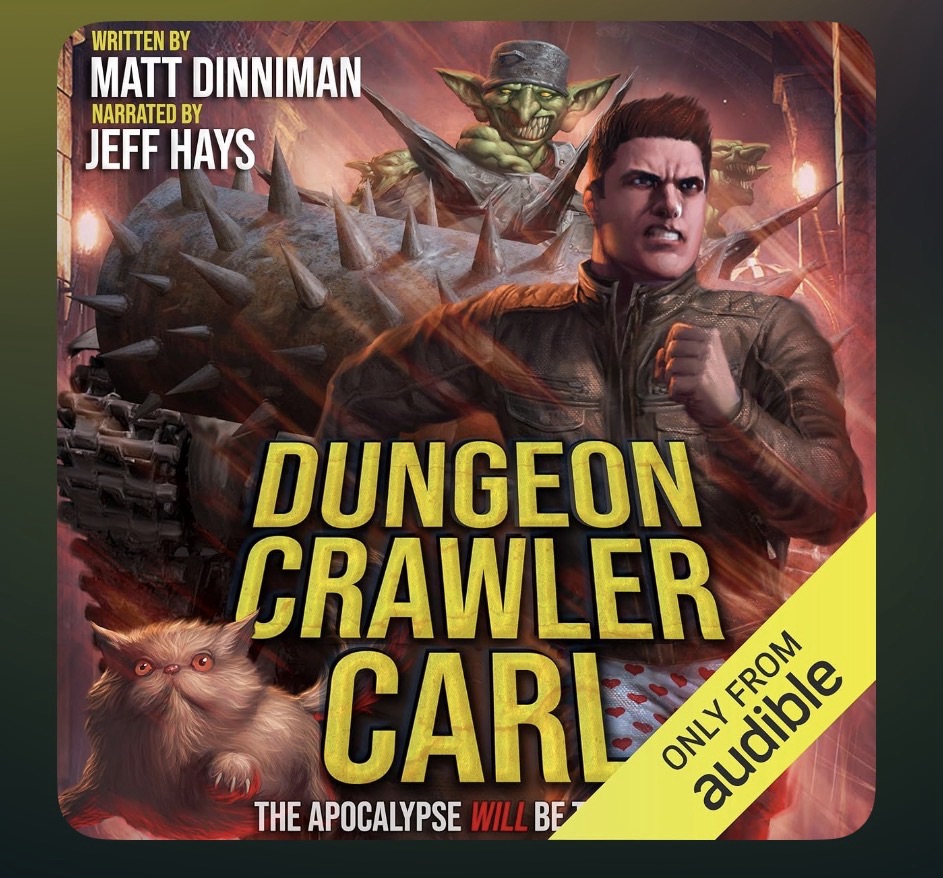
    Carl is a former member of the Coast Guard who, along with Princess Donut (his ex-girlfriend’s cat) survives the rather sudden transformation of Earth into an eighteen-level dungeon. And it turns out it’s not just a dungeon; it’s an intergalactic reality TV show!

    Let’s get something out of the way. Yes, this book is worth the hype. Yes, if you like sci fi and fantasy with heart and humour, you’ll probably like Dungeon Crawler Carl. The book is a heady blend of Hitchhiker’s Guide to the Galaxy, The Hunger Games, and Dungeons & Dragons. The humour is irreverent and at times absurd, but the story has heart and emotional weight.

    For a start, it’s well written. Dinniman does the basics well. Details introduced early in the story reappear later with satisfying pay off. The dungeon is well-designed, with cool mechanics and layout. And there’s a vast world outside the dungeon that’s strongly hinted at. It has depth in its politics, corporations, and inhabitants, all of which feel richly conceived. The use of TV talk shows as a device for revealing what’s happening beyond the dungeon walls works really well as a technique.

    The characters are brilliant. Carl and Princess Donut are both excellent. They’re funny and loveable, and their dynamic carries the book when the stakes are both low and high.

    And I don’t normally comment on the medium of my book consumption, but I feel a special mention is needed for the audiobook, which is very well produced. Jeff Hays’ narration adds texture and personality to the story, and in many ways elevates and adds to the experience.

    So, yes, I recommend this. At the time of writing this review, I’m already on book 3… which probably tells you all you need to know!

  • Book Review: The Summer Tree

    Book Review: The Summer Tree

    Content Warning: This review discusses a book containing sexual assault.

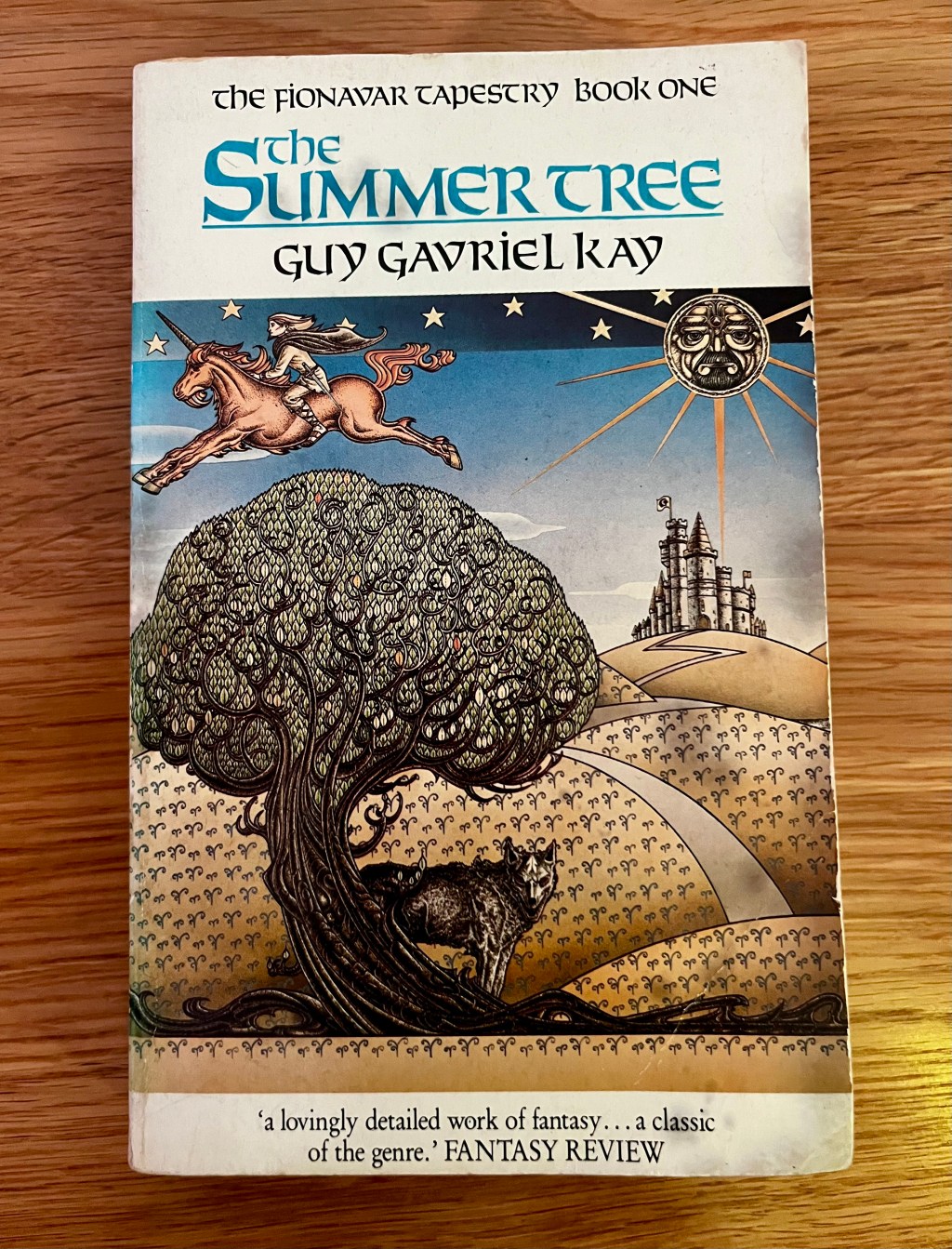
    The Summer Tree, a richly imagined fantasy adventure, is the first of Guy Gavriel Kay’s Fionavar Tapestry trilogy. The novel follows five university students from Toronto who are transported to Fionavar, the ‘first of all worlds’, where they become entangled in an ancient conflict against a dark god breaking free from imprisonment.

    Kay’s worldbuilding is probably the highlight of the novel. The magic system, where mages must be tied to other individuals who serve as ‘sources’ of power, is a nice mechanic. Also nicely done is the imprisonment of dark god Rakoth Maugrim beneath a mountain. The mountain looms visibly in the landscape as a prison in plain sight of all who live there. And the ritual of the Summer Tree itself introduces a compelling concept: kings are traditionally expected to sacrifice themselves during times of crisis, offering their lives to the gods. But they can send others in their place, and this puts one of the protagonists in an interesting position. Throughout, the metaphor of a tapestry and a weaver (symbolising fate and determinism) is contrasted with the dark god—the ‘unweaver’.

    The narrative mostly focuses on its classical fantasy setting—think kings and castles and mages—but it takes a refreshing turn in the final third when we finally reconnect with Dave, the fifth member of the transported group, who went missing during the journey into Fionavar. Kay’s incorporation of Native American-inspired elements here adds a level of cultural diversity to what otherwise might have been a purely European-inspired fantasy setting. The pacing of the story is fine, and the prose is accessible throughout. There’s the odd name you have to remember, but you’re not drowned in unnecessarily complicated language.

    Of the ensemble cast, certain characters stand out with more memorable moments and clear arcs. Paul, driven by grief, finds his place on The Summer Tree; Kevin’s personality comes through. However, this is also where some of the novel’s weaknesses emerge. With five modern-day characters thrust into this fantasy realm, Kay effectively shows different reactions to this strange new world, but this breadth comes at the cost of depth for some characters. We get more substantive development for some protagonists, while others remain relatively undeveloped.

    This imbalance is particularly noticeable in the female characters, both from our world and Fionavar itself. Too often, women in the narrative exist primarily as romantic interests, objects of desire, or victims of violence. In the final pages, there is an instance of sexual assault—unnecessarily graphic as far as I was concerned—as a plot device to show how evil the dark god is. Reading this book forty years after it was first published, it certainly feels dated in this regard.

    Kay has earned comparisons to Tolkien, and not undeservedly so. His own work with Christopher Tolkien in drawing together the stories for the The Silmarillion undoubtedly impacted him, and he has brought to the genre a blend of different mythologies and influences. But I don’t think I was so enamoured by this book that I’d want to continue the trilogy.

  • The Edge Chronicles

    The Edge Chronicles

    This series will forever be one of my favourites. It was my favourite as a boy and, rereading the books now, I’m still in love. And how could I not be? The world is expansive and diverse, the characters are relatable and compelling, and the illustrations are beautiful (especially in the print books—the ebook version, perhaps not so much… the limitations of technology! Though the maps and many illustrations are available from the official website).

    The series is set on The Edge, a jutting piece of rock that sits amidst a vast expanse—no one has travelled far enough over the edge (outward, upward, or downward) and returned. A river flows into nothingness. But on The Edge are lush and dangerous forests, barren wastelands, marshes and mires, towns and cities (including the floating city of Sanctaphrax). The world is populated by a wide variety of different creatures, some coexisting, some not, from humans to humanoid beings, spindly-legged spider-like creatures, flesh-eating trees, giant banderbears, and much more in between.

    The series follows The Edge at different stages, with storylines focusing on a core of interrelated characters, all descendants of the same family across different generations. The epochs are defined by the stages of flight they go through, from ships mounted with lighter-than-air stones (flight rocks) able to keep them afloat in the sky, to specially varnished buoyant woods, to more industrial sky ships powered by stormphrax. 

    Sky pirates feature heavily, especially in the first two trilogies centred on Twig and Quint (one of the key reasons, obviously, why I love it), and the stories are bound together by sweeping adventures. The reader is taken to the variety of places across The Edge, and they meet numerous different peoples and societies, all wonderfully imagined. Within this world, the stories are able to tackle different themes: race and difference, identity and belonging, nature and industry, slavery and freedom—alongside the more familiar themes of good and evil, right and wrong.

    The world created by Paul Stewart and Chris Riddell is captivating and formidable. Enter at your peril, and be prepared to be swept along in breathless adventures to the farthest reaches of the land—and beyond!