Tag: robots

  • Book Review: All Systems Red

    Book Review: All Systems Red

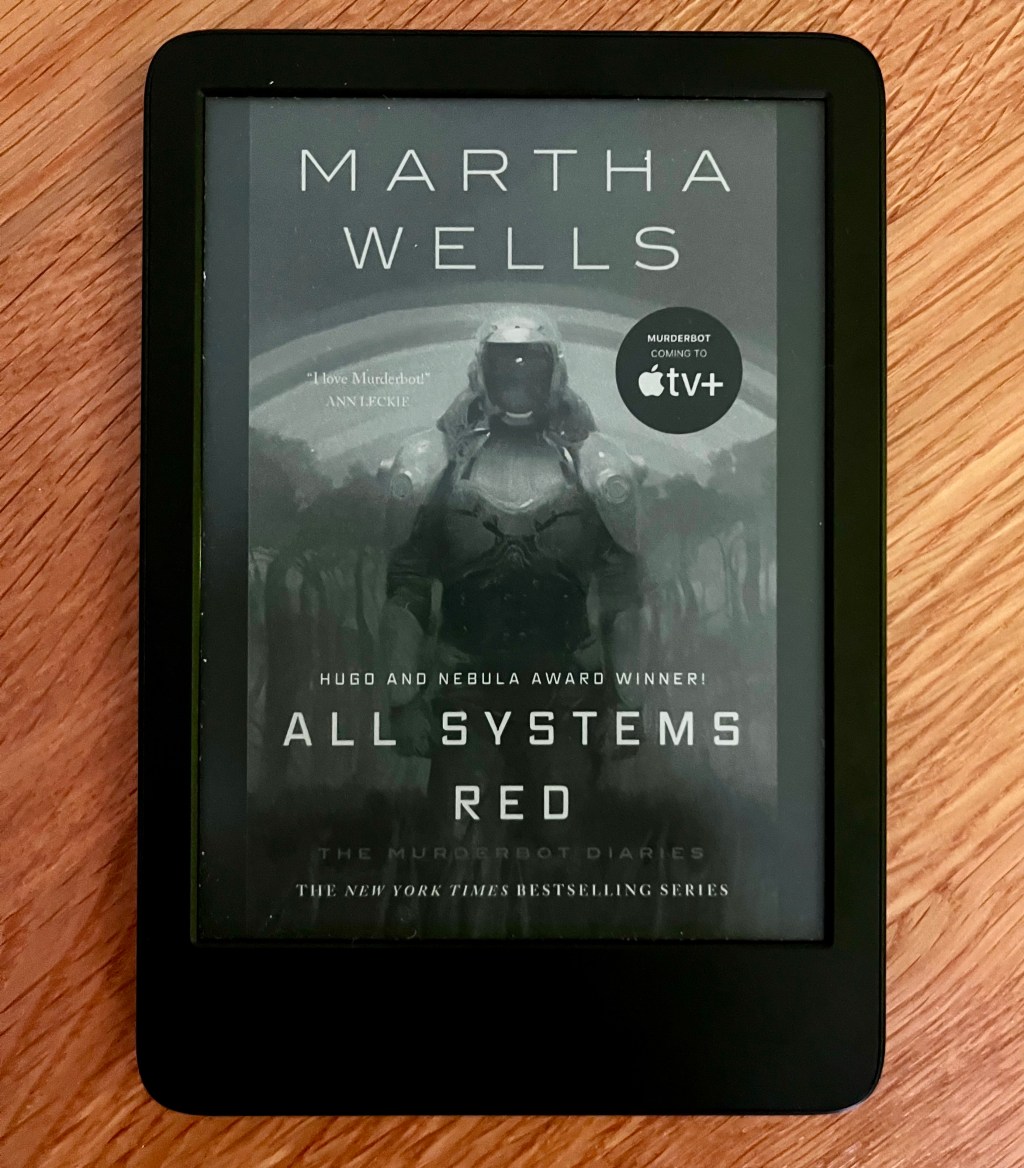
    In a corporate-dominated spacefaring future, planetary missions must be approved and supplied by the Company. Exploratory teams are accompanied by Company-supplied security androids, for their own safety.

    But in a society where contracts are awarded to the lowest bidder, safety isn’t a primary concern.

    On a distant planet, a team of scientists are conducting surface tests, shadowed by their Company-supplied ‘droid — a self-aware SecUnit that has hacked its own governor module, and refers to itself (though never out loud) as “Murderbot.” Scornful of humans, all it really wants is to be left alone long enough to figure out who it is.

    But when a neighboring mission goes dark, it’s up to the scientists and their Murderbot to get to the truth.

    All Systems Red by Martha Wells is the first instalment of the Murderbot Diaries, published in 2017. So, yes, I’m a little late to the party.

    This is my first Murderbot read, and my first Martha Wells read, too. And I loved it. This is short-form sci-fi at it’s best. The main character, Murderbot, is an endearing mixture of insecure, anti-social, and self-effacing. Murderbot is part machine, part organic, but wholly constructed as a security unit. And it is able to hack into its ‘governor module’, the part of its circuitry that forces it to abide by external commands and protocols, and become self-determining. 

    Despite its best efforts, Murderbot, who would rather watch endless serials from the entertainment feeds, becomes attached to the human scientists who have rented it from the ‘Company’, a corporate entity who supply subpar supplies and materials for interplanetary exploration.

    To keep the book short and accessible, the world-building is fairly light, focusing around familiar themes of rogue robots and hacked computer networks, in a universe dominated by corporations and corporate interests. This works well, and the reader is able to focus on the characters and their relationships to one another—Murderbot, of course, as our perspective character, but the others, too: the calm leader, the sceptic distrustful of Murderbot, the empathetic scientists keen to draw out Murderbot’s emotional side. Through their interactions with Murderbot, we get a window into their different personalities. We also explore our protagonist’s anxieties and struggles—showing that, despite being a SecUnit, Murderbot could be just as human as the scientists it’s protecting. Throughout, the robot bounces between analytical and emotional, detached and invested.

    At the heart of the plot is a mystery that unfolds at a steady pace across the pages. It thumps along with a steady staccato, with revelations at each stage that keen the reader interested. The unraveling of the mystery is satisfying and helps flesh out the broader world that Murderbot and the scientists are operating in. So, in learning more about the mysterious forces at play, we learn more about how the corporate universe works—an effective use of words in a short novel!

    This series came recommended to me by a number of people, and I am deeply thankful for that. The novel takes familiar sci-fi elements (AI, corporate dominance of space) and explores them through the lens of an engaging and relatable protagonist. I am happy to pass on the recommendation to anyone who hasn’t yet read All Systems Red!
  • Covid and The Naked Sun

    Covid and The Naked Sun

    Isaac Asimov had a particular talent for making the setting part of the story; in his murder mystery portion of the Robots series, the detective work involves not just solving the case, but understanding new and strange worlds with deep cultural differences and political infrastructures. When Elijah Bailey sets foot on Solaria in The Naked Sun, he experiences the titular ball of flame in the sky, so alien from the Caves of Steel (the titular environment in the first novel of the series) he was used to. And he encounters a society where robots outnumber humans by a factor of ten thousand, and with an entire human population of twenty thousand: people are scattered and isolated across the planet.

    Stepping into this new world is not so dissimilar to the world that we inhabited just a few years ago. Reading The Naked Sun in the post-Covid era, the similarities are striking (speaking once more to the brilliance of Asimov’s foresight). Bailey, moving from a densely populated, comparatively disease-ridden Earth, finds the shift in social norms confusing and strange. No one wants to come within ten feet of him; they all wear nose plugs and gloves in his presence (if they can bear to be in his presence at all). We found ourselves as Solarians in those months and years from 2020; we wore masks and gloves, came not within six feet of one another; how alien we became to ourselves. Had someone in 2019 jumped forward in time a year, they would have been like Bailey stepping foot on a new planet.

    And, like the Solarians, in our isolation we became reliant on our technology. The pandemic was a boon for tech firms like Zoom, whose share prices rose (and later fell) dramatically. Like in Solaria, whose main form of communication was ‘tridimensional viewing’, an advanced form of holographic communication where the person viewed was almost convincingly present, we found ourselves using video calling and video conferencing, even to the point of fatigue. Though our technology is not so advanced as that of the Solarians, we still experienced joining with others virtually (and still do), on our phones, laptops, and TVs.

    Underpinning both our societies was a fear of contamination. So obsessed were we, like the Solarians, with avoiding disease that we remained distant and isolated. Unlike the Solarians, we have been quick to recognise the harm that this has on our personal relationships. Social interaction via Zoom can only satiate the need for human contact so much. Yet Solarian society, in a warning to us all, became entrenched in such isolation. Gladia, a native of Solaria with whom the protagonist forms a relationship, is only one of few to recognise the damage this is causing her.

    Indeed, on Solaria this separation is politicised, legally entrenched; in our world, there were fears, many legitimate, some extreme, that government imposition of lockdowns, travel restrictions, and quarantine would give those in power a taste of authoritarianism. That they would, in turn, create a society like Solaria. Such a thing might not be unthinkable: the reliance of Solarians on robotics and automated labour is a key reason of their isolation; automation of labour in our world could be a similar lever of control. Indeed, new technology and automated production has, since the 1970s, undermined collective bargaining and weakened unions, contributing to stagnant wage growth and worsening inequality. In Solaria, the small population are the landed gentry, the robots their serfs. What happened to the human working class?

    And yet we have evaded and escaped from much of the Covid restrictions, which have proved, for the most part, temporary. As humans we were able to adapt to our limited conditions in the short term, and we have been resilient enough in the long term to revert back to our old ways. But when we visit a new world and come home, a part of that world stays with us. When Bailey returns to Earth, he does something he never would have done before: he leaves the City, his Cave of Steel, and starts a movement; he goes outside and stands beneath the Naked Sun.