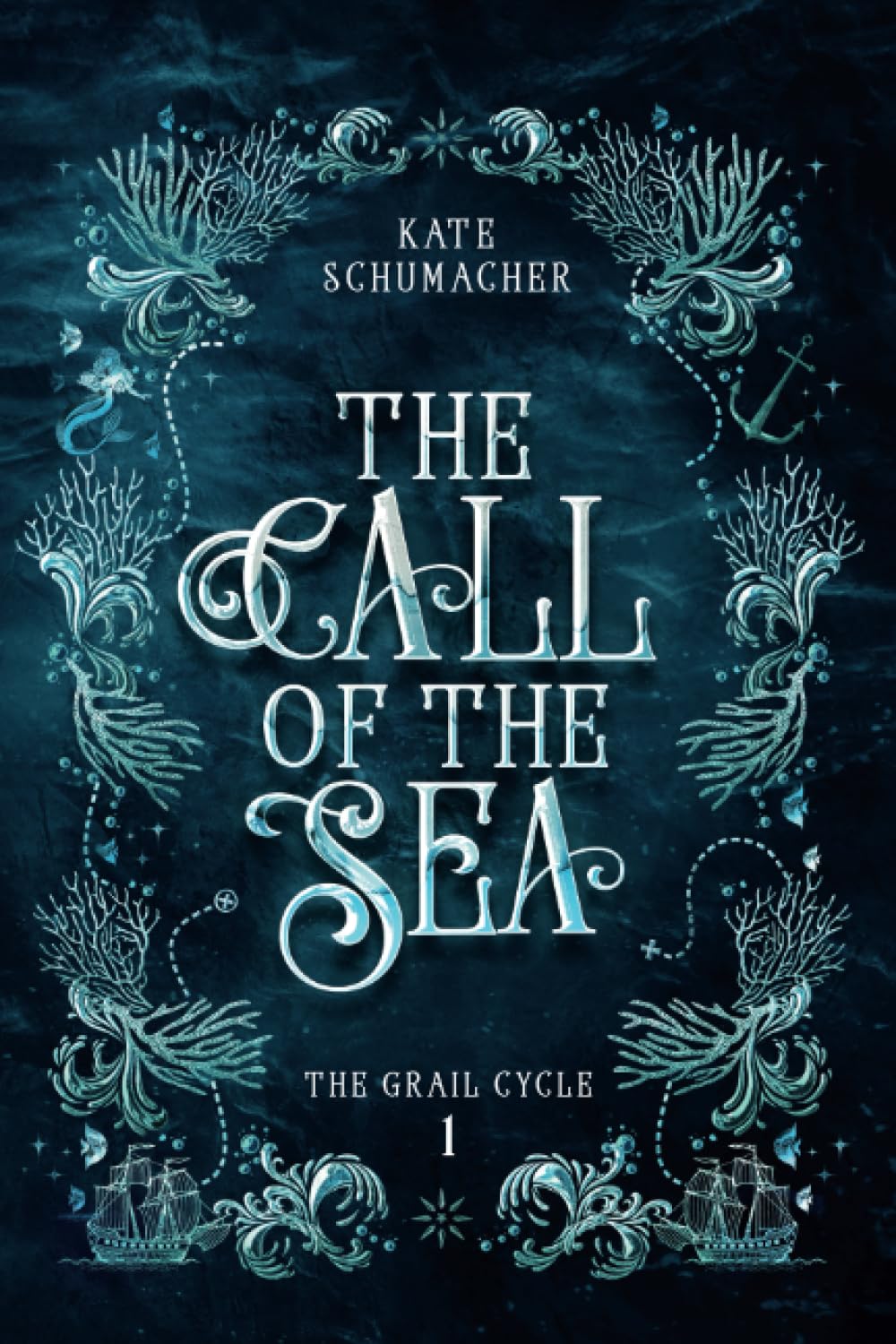
The Call of the Sea by Kate Schumacher is a maritime take on the Arthurian legends, told with an ensemble of characters and through multiple viewpoints. It is set in a land being changed—not for the better—by a monotheistic, orthodox religion (a thinly veiled critique of christianity) that seeks to keep women bound in their homes and sees homosexuality as sinful and shameful. It also seeks to rid the world of its old magic and those who can control it (hypocritically, of course, given that to detect magic one must possess magic). A series of events leads its three core characters—Jenyfer, Ordes and Arthur—on a mission to find themselves, find each other, and, yes, find the grail.
The story is beautifully told, with vivid descriptions of the scenery and subtle world building. At the heart of the story are the relationships between the characters, romantic and otherwise, and they are deliciously lustful and thirsty for each other (be prepared for lots of burning flesh and clenching legs). The pacing is consistent and slow, with plenty of time for reflection and characterisation. This might put some people off, but it is deliberate, and it works, and people looking for a break from breakneck pace will find something to love here.
Given its emphasis on the persecution of women and gay people, the author is not afraid to tackle difficult subjects. There are some graphic scenes, so just be warned going in.
The first in a trilogy, this book does more to set up the characters and the problems affecting the world, so don’t expect much resolution as you get to the end. But, given the richness and depth of the world, I don’t doubt that after finishing this you will be hungry for the next instalment.
Margaret Atwood’s The Handmaid’s Tale is a dystopian novel set in a near-future patriarchal world, following Offred, the titular handmaid (i.e., a woman whose role in society is solely to get pregnant). The Republic of Gilead in which Offred lives is rigid and highly religious, oppressive and authoritarian. Women go through a process of reeducation in training for their new roles, and memories of the time before the revolution that brought the Republic about are hazy. The novel was arresting enough when it was published in 1985, but it has taken on a new salience with the resurgence of the fanatical evangelical Right in America—the faction most devoted to the ironically areligious and immoral Trump.
A key theme of the book is the use of religion as a vessel for power. The Republic of Gilead isn’t based on any meaningful interpretation of religious scripture; rather, religion is a tool for exercising control. Similarly, with Trump’s evangelical base, it does not matter that Trump is a liar and an adulterer—and embodiment of many other sins besides. They see him as a hammer, a tool with which to exercise their will over the population. For as long as he serves their interests (see: social conservatism, anti-abortion, anti-LGBTQ+ rights, and more), they will follow him, regardless of his character. Leaders of evangelical groups will willingly overlook these flaws and contradictions if it means greater power for themselves and their ideologies.
The book highlights the dangers of the intersection of religion and politics, in particular where the former coopts the latter. When the separation of church and state is eroded, this is devastating for women, religious, sexual, and ethnic minorities, and anyone who doesn’t fit neatly with the ‘in-group’ (in this case, White, Anglo-Saxon, Protestant). Civil liberties are eroded—in the book, people are murdered and pinned against a wall in medieval fashion for all to see.
Most striking is the wrestle for control over women’s bodies. In The Handmaid’s Tale this takes the form of reproductive rights. Certain women are given the right to have children, though they will not become the children’s mothers—that role goes to someone else—at the expense of all other rights to self-determination. The scary thing is that this is not so far-fetched; today, religious conservatives are eroding hard-won rights, in particular reproductive rights and access to reproductive medical facilities, abortion rights, and adoption rights for LGBTQ+ couples.
Frighteningly, the novel is resonant not just in America, where it is set, but elsewhere in the world. Germany, France, Sweden and elsewhere are seeing an insurgent Right; the incumbent party in the UK is being split between its centre-right and more fanatical fringes. In other countries, such as India, the dominant party is explicitly religious and is shored up by its majority religion base. All this to say that democracy is fragile, and when people fall victim to economic misfortune or experience cultural shifts, the mechanisms of democracy can be weaponised by bad actors against minorities and vulnerable groups. The media can, and often does, play a part in this, too, especially when a few large corporations own multiple outlets. The organisations spread lies and misinformation, and stoke paranoia.
Like with all good dystopian novels, The Handmaid’s Tale is incredibly prescient; the prospect of such a future coming into fruition is alarmingly real. But the novel is not just a story about a horrifying future; it is a story of resistance. And the future it describes is a future we must be prepared to face head on and challenge at every opportunity.
 Peter R. S. Thomas