Tag: reading

  • Book Review: The Colour of Magic

    Book Review: The Colour of Magic

    The Colour of Magic introduces readers to Terry Pratchett’s Discworld—a flat planet balanced on the backs of four elephants standing on a giant turtle swimming through space. The story follows Rincewind, a wizard capable of performing only one spell, who reluctantly becomes the guide for Twoflower, the Disc’s first tourist, complete with his magical luggage that follows him on hundreds of tiny legs. Their misadventures take them across the Disc as they flee assassins, dragons, and the whims of gods.

    What I loved most was the dynamic between Rincewind and Twoflower. It strikes a perfect balance between the cynical wizard and the wide-eyed tourist, creating a classic contrast of worldviews. I loved the interplay here—Rincewind desperate to avoid adventure, Twoflower open to exploring and nonchalant about the consequences.

    The prose is great; I’ve heard some people say that they’re not so keen on Pratchett’s earlier work and it takes him a few books to hone his style, but even still I really like it. What I think is key is his ability to imply rather than explain. He often shows reactions or outcomes, trusting readers to fill in what happened. It misfires from time to time (occasionally I misinterpret what happens), but this  is rare, and on balance I find it really effective.

    The four-part structure of The Colour of Magic gives the novel an enjoyable episodic quality, allowing us to experience the different corners of Discworld while exploring the interplay between gods and the fundamentals of magic. We move through different parts of the world, visiting Ankh-Morpork, then woods and temples, dragons, to the very edge of the Disc, in a really fun and varied way. 

    And, at its core, we get this really loving satire and parody of fantasy tropes. This is what makes Pratchett’s work distinctive—there’s an affectionate mockery of a genre he clearly adores, in this case some of the classic sword and sorcery works. All this as part of fantastic and rich world building that incorporates modernist themes, religion, bureaucracy, and other carefully selected and well represented targets of gentle mockery.

    My only criticism lies in the transition between the third and final parts, where it felt like something significant occurred off-page. There was a momentary disconnect for me that was more jarring than the book’s other scene shifts. But otherwise I loved it, and I love Pratchett, and it’s been a great experience revisiting some of his work.
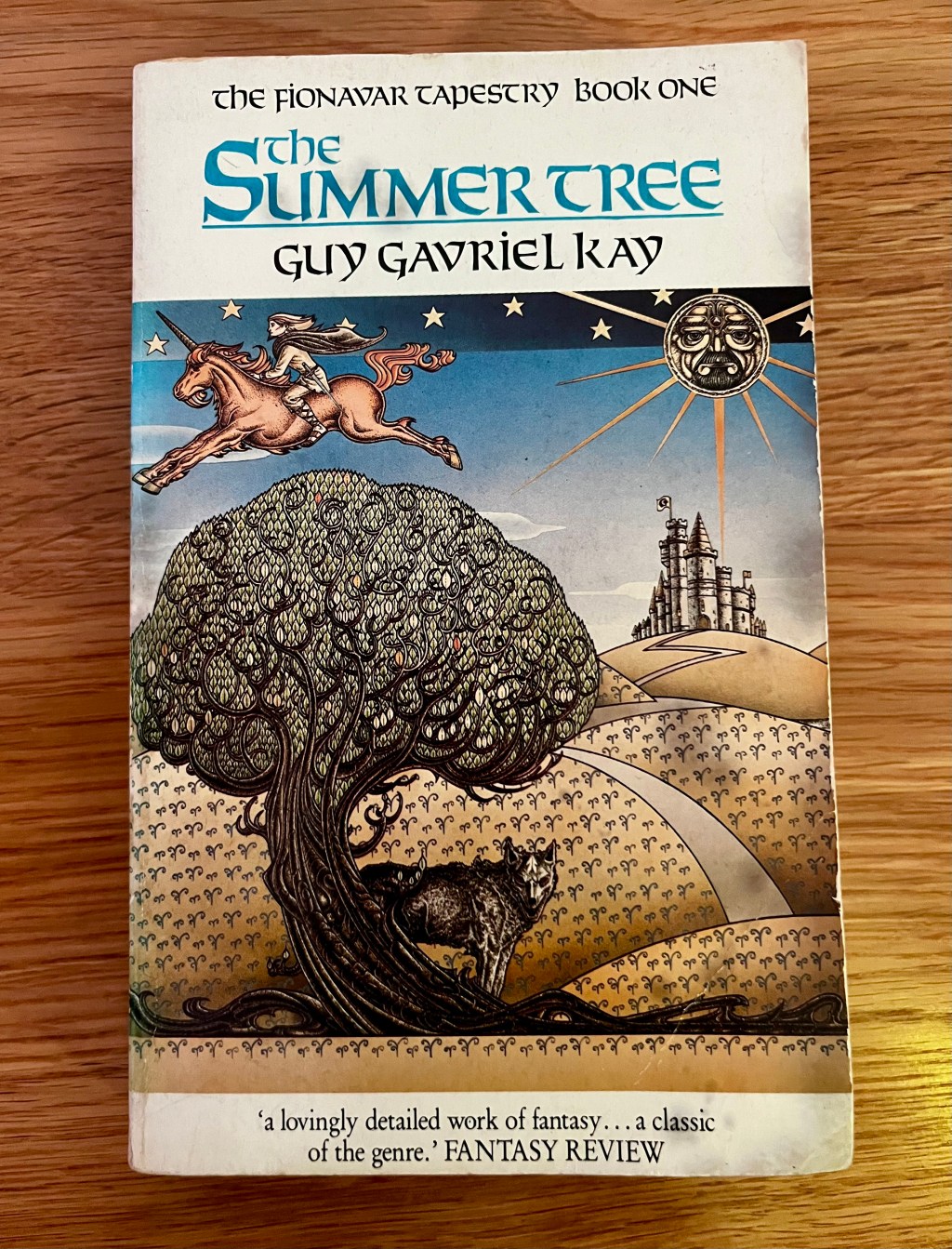
  • Book Review: The Summer Tree

    Book Review: The Summer Tree

    Content Warning: This review discusses a book containing sexual assault.

    The Summer Tree, a richly imagined fantasy adventure, is the first of Guy Gavriel Kay’s Fionavar Tapestry trilogy. The novel follows five university students from Toronto who are transported to Fionavar, the ‘first of all worlds’, where they become entangled in an ancient conflict against a dark god breaking free from imprisonment.

    Kay’s worldbuilding is probably the highlight of the novel. The magic system, where mages must be tied to other individuals who serve as ‘sources’ of power, is a nice mechanic. Also nicely done is the imprisonment of dark god Rakoth Maugrim beneath a mountain. The mountain looms visibly in the landscape as a prison in plain sight of all who live there. And the ritual of the Summer Tree itself introduces a compelling concept: kings are traditionally expected to sacrifice themselves during times of crisis, offering their lives to the gods. But they can send others in their place, and this puts one of the protagonists in an interesting position. Throughout, the metaphor of a tapestry and a weaver (symbolising fate and determinism) is contrasted with the dark god—the ‘unweaver’.

    The narrative mostly focuses on its classical fantasy setting—think kings and castles and mages—but it takes a refreshing turn in the final third when we finally reconnect with Dave, the fifth member of the transported group, who went missing during the journey into Fionavar. Kay’s incorporation of Native American-inspired elements here adds a level of cultural diversity to what otherwise might have been a purely European-inspired fantasy setting. The pacing of the story is fine, and the prose is accessible throughout. There’s the odd name you have to remember, but you’re not drowned in unnecessarily complicated language.

    Of the ensemble cast, certain characters stand out with more memorable moments and clear arcs. Paul, driven by grief, finds his place on The Summer Tree; Kevin’s personality comes through. However, this is also where some of the novel’s weaknesses emerge. With five modern-day characters thrust into this fantasy realm, Kay effectively shows different reactions to this strange new world, but this breadth comes at the cost of depth for some characters. We get more substantive development for some protagonists, while others remain relatively undeveloped.

    This imbalance is particularly noticeable in the female characters, both from our world and Fionavar itself. Too often, women in the narrative exist primarily as romantic interests, objects of desire, or victims of violence. In the final pages, there is an instance of sexual assault—unnecessarily graphic as far as I was concerned—as a plot device to show how evil the dark god is. Reading this book forty years after it was first published, it certainly feels dated in this regard.

    Kay has earned comparisons to Tolkien, and not undeservedly so. His own work with Christopher Tolkien in drawing together the stories for the The Silmarillion undoubtedly impacted him, and he has brought to the genre a blend of different mythologies and influences. But I don’t think I was so enamoured by this book that I’d want to continue the trilogy.

  • Book Review: The Great Gatsby and Brideshead Revisited

    Book Review: The Great Gatsby and Brideshead Revisited

    I’ve just finished reading The Great Gatsby for the first time, and yes, I can see why it’s become a classic of American literature. The underlying themes, the gradual reveal of the Gatsby’s elusive past, the inevitable tragedy, are subtle and enduring. It reminded me of Brideshead Revisited in a way. The tragic nature of wealth, the decay beneath all that glitz and glamour—Gatsby is to American literature what Brideshead is to English.

    Both are narrated by outside observers, Nick Carraway (Gatsby) and Charles Ryder (Brideshead). And both of these men are drawn into the world of wealth from modest backgrounds, and both are simultaneously invested and detached in what they see. Nick establishes a relationship with Jordan Baker, a socialite part of Gatsby’s world, and Charles with Julia, the sister of Sebastian Flyte. And both watch as Gatsby and Sebastian struggle through their personal issues.

    Those observed are haunted in their own way by their past. Gatsby is obsessed with Daisy Buchanan, while Sebastian and his family are consumed by their heritage, the death of the English nobility and struggling Catholic traditions. And Gatsby and Sebastian’s family are both eventually consumed—Gatsby is killed following the attempted renewal of his relationship with Daisy, and Sebastian descends into alcoholism.

    But there are, of course, key differences. Brideshead’s driving theme is the Catholic religion and English aristocracy; Gatsby’s is the American Dream, a quasi-religion in itself, I suppose, and chased with similar fervour. Fitzgerald critiques a particular form of social mobility and how it can be achieved, and amidst this the hidden classes that define American society, while Waugh explores, with nostalgia, the decline of English nobility, its relationship to faith, education, and tradition. Significantly, wealth, for Gatsby, comes from questionable means, and for the Flytes, wealth is inherited and comes with its own obligations. But, of course, wealth ends up destroying them both, and the people they love.

    Do these differences reveal the contrasting nature of English and American societies? Or do they simply represent the differing perspectives of their authors on the nature of wealth and status? There’s something of both, clearly, in this. But regardless, both are significant reads.

  • Why Fantasy, Why Now

    Why Fantasy, Why Now

    The world is a little bit on fire right now. Climate change is getting worse. Politics have taken a shift to the right, threatening the rights of historically marginalised peoples. Technology is developing at a rapid pace—creatives are being displaced, jobs are under threat.

    In this world, Fantasy occupies a special place. It offers an escape, yes, but not just escapism—it’s a lens through which we can view and process our reality.

    Firstly, Fantasy gives us the freedom to isolate a problem and task a character with finding a solution. The problem can reflect something we face in our real world. In doing so, the reader is given the opportunity to consider the solution space. With our protagonists, we explore what the various options are.

    From Frodo in The Lord of the Rings to Vin in Mistborn, our heroes are challenged to take on evil and oppression. They try different ways to solve their problem. They fail, and get back up—this is what keeps them relatable, and the reader cheering them on—until they find something that works. 

    And it isn’t just about finding strength and power: Kvothe in The Name of the Wind shows us how intelligence and wit can be used to fight a struggle against poverty. We seem him struggle at numerous times, and we’re with him as he explores ways to attend the University, despite his background.

    In most stories, in the struggle between good and evil, good (usually) ends up on top. (Not always, but usually!) This gives us hope that the struggles we face will one day be resolved. We also learn the costs associated with different actions, the drawbacks, the mistakes—the things we may want to avoid rather than repeat. Through such works, we learn not just what to do, but what to avoid, and how to think critically about our own world’s challenges.

    Mistborn begins in a world where evil has already won, yet our heroes still find a path toward hope and redemption. Hope emerges here from a seemingly hopeless world. In contrast, Legends & Lattes reveals to us smaller victories, more personal, where an orc warrior who has tired of adventure can find fulfilment in opening a coffee shop (and in the relationships she forges along the way).

    A core aspect of Modern Fantasy is the exploration of oppression and difference, race and culture, sexuality and gender identity. Through Fantasy, people who may not have a voice in our world are given time to speak, to explore their concerns, to be heroes and represent the power to change. Above all, even though many of the creatures and peoples we encounter are not human, Fantasy helps us explore and understand our common humanity, our shared personhood and experience.

    Terry Pratchett’s Guards, Guards! and Men at Arms (and numerous other works, honestly, but I pick these as they’re fresh in my mind!) explores class discrimination and systematic inequality through the members of the City Watch. Here, peoples of different races and backgrounds and genders explore and overcome their differences in ways that are humorous, touching, and sincere. Similarly, the Edge Chronicles presents a world where many creatures (from Banderbears to Sky Pirates) must learn to coexist despite their differences.

    When the world around us gets too much, Fantasy allows us to disappear into a world unlike our own, full of mystery and adventure. But that does not mean we are running away. Like the heroes in our stories, we enter these worlds not to abandon reality, but to return changed and better equipped to face it. The best stories don’t just transport us: they transform us.

    Much of this is, of course, true of Science Fiction as well. Where Fantasy uses far off worlds and systems of magic to explore these issues, Sci-Fi uses far off futures and technological changes. Asimov’s Foundation series explores how civilisations can deal with large-scale crises; through Do Androids Dream of Electric Sheep? we question our humanity in a world of advancing technology; similar questions are raised in Asimov’s Baley—Olivaw series (my favourite being The Naked Sun) where the closing gap between robot and human, and the restructuring of human society around that, is explored.

    From finding solutions to considering mistakes, from giving marginalised peoples a voice to giving us the strength to face our world, literature is powerful. And it’s needed now, more than ever. So tell me, what about you? How have the stories you love changed you or given you strength?