Content Warning: This review discusses a book containing sexual assault.
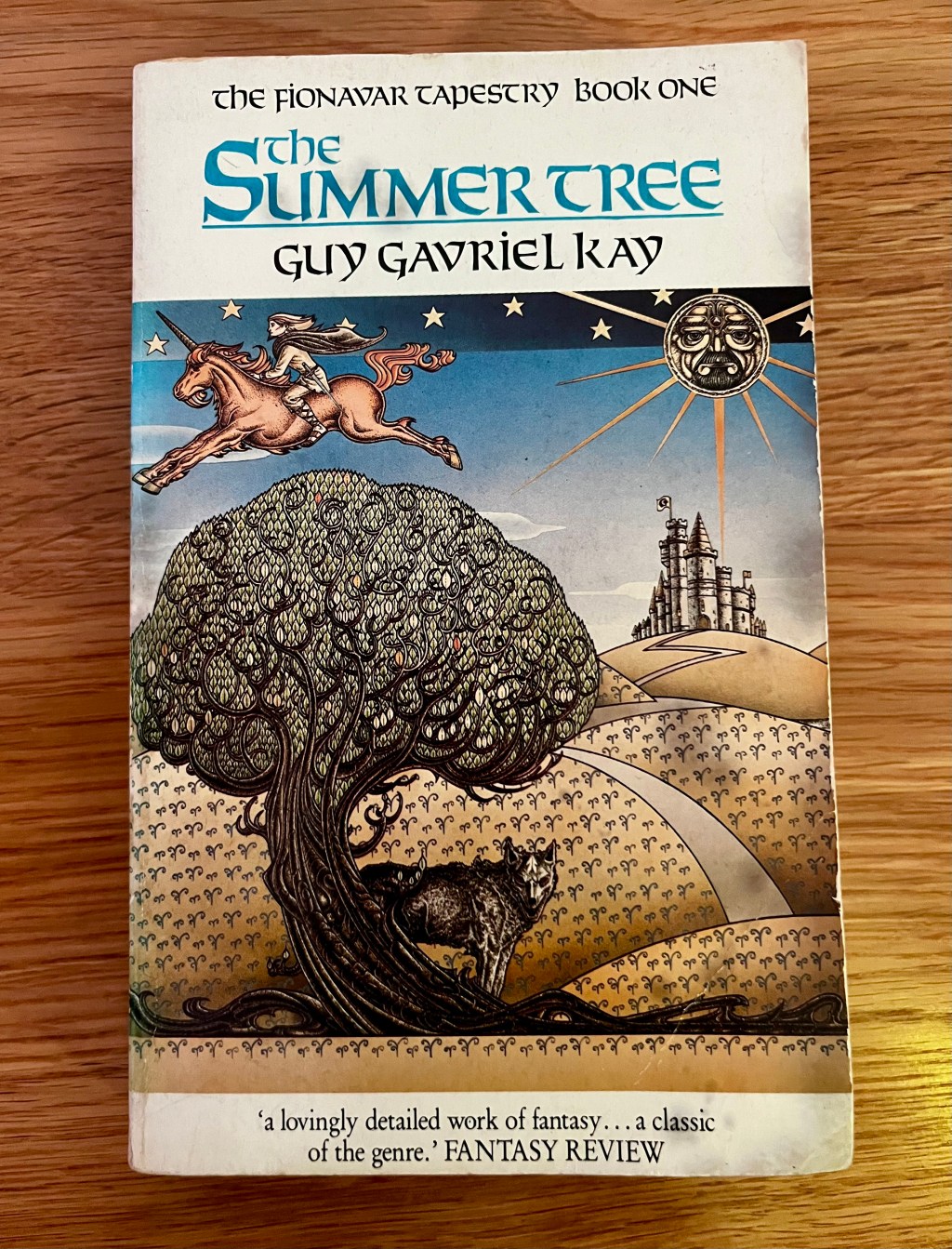
The Summer Tree, a richly imagined fantasy adventure, is the first of Guy Gavriel Kay’s Fionavar Tapestry trilogy. The novel follows five university students from Toronto who are transported to Fionavar, the ‘first of all worlds’, where they become entangled in an ancient conflict against a dark god breaking free from imprisonment.
Kay’s worldbuilding is probably the highlight of the novel. The magic system, where mages must be tied to other individuals who serve as ‘sources’ of power, is a nice mechanic. Also nicely done is the imprisonment of dark god Rakoth Maugrim beneath a mountain. The mountain looms visibly in the landscape as a prison in plain sight of all who live there. And the ritual of the Summer Tree itself introduces a compelling concept: kings are traditionally expected to sacrifice themselves during times of crisis, offering their lives to the gods. But they can send others in their place, and this puts one of the protagonists in an interesting position. Throughout, the metaphor of a tapestry and a weaver (symbolising fate and determinism) is contrasted with the dark god—the ‘unweaver’.
The narrative mostly focuses on its classical fantasy setting—think kings and castles and mages—but it takes a refreshing turn in the final third when we finally reconnect with Dave, the fifth member of the transported group, who went missing during the journey into Fionavar. Kay’s incorporation of Native American-inspired elements here adds a level of cultural diversity to what otherwise might have been a purely European-inspired fantasy setting. The pacing of the story is fine, and the prose is accessible throughout. There’s the odd name you have to remember, but you’re not drowned in unnecessarily complicated language.
Of the ensemble cast, certain characters stand out with more memorable moments and clear arcs. Paul, driven by grief, finds his place on The Summer Tree; Kevin’s personality comes through. However, this is also where some of the novel’s weaknesses emerge. With five modern-day characters thrust into this fantasy realm, Kay effectively shows different reactions to this strange new world, but this breadth comes at the cost of depth for some characters. We get more substantive development for some protagonists, while others remain relatively undeveloped.
This imbalance is particularly noticeable in the female characters, both from our world and Fionavar itself. Too often, women in the narrative exist primarily as romantic interests, objects of desire, or victims of violence. In the final pages, there is an instance of sexual assault—unnecessarily graphic as far as I was concerned—as a plot device to show how evil the dark god is. Reading this book forty years after it was first published, it certainly feels dated in this regard.
Kay has earned comparisons to Tolkien, and not undeservedly so. His own work with Christopher Tolkien in drawing together the stories for the The Silmarillion undoubtedly impacted him, and he has brought to the genre a blend of different mythologies and influences. But I don’t think I was so enamoured by this book that I’d want to continue the trilogy.
 Peter R. S. Thomas