Tag: Fantasy

  • Book Review: The Summer Tree

    Book Review: The Summer Tree

    Content Warning: This review discusses a book containing sexual assault.

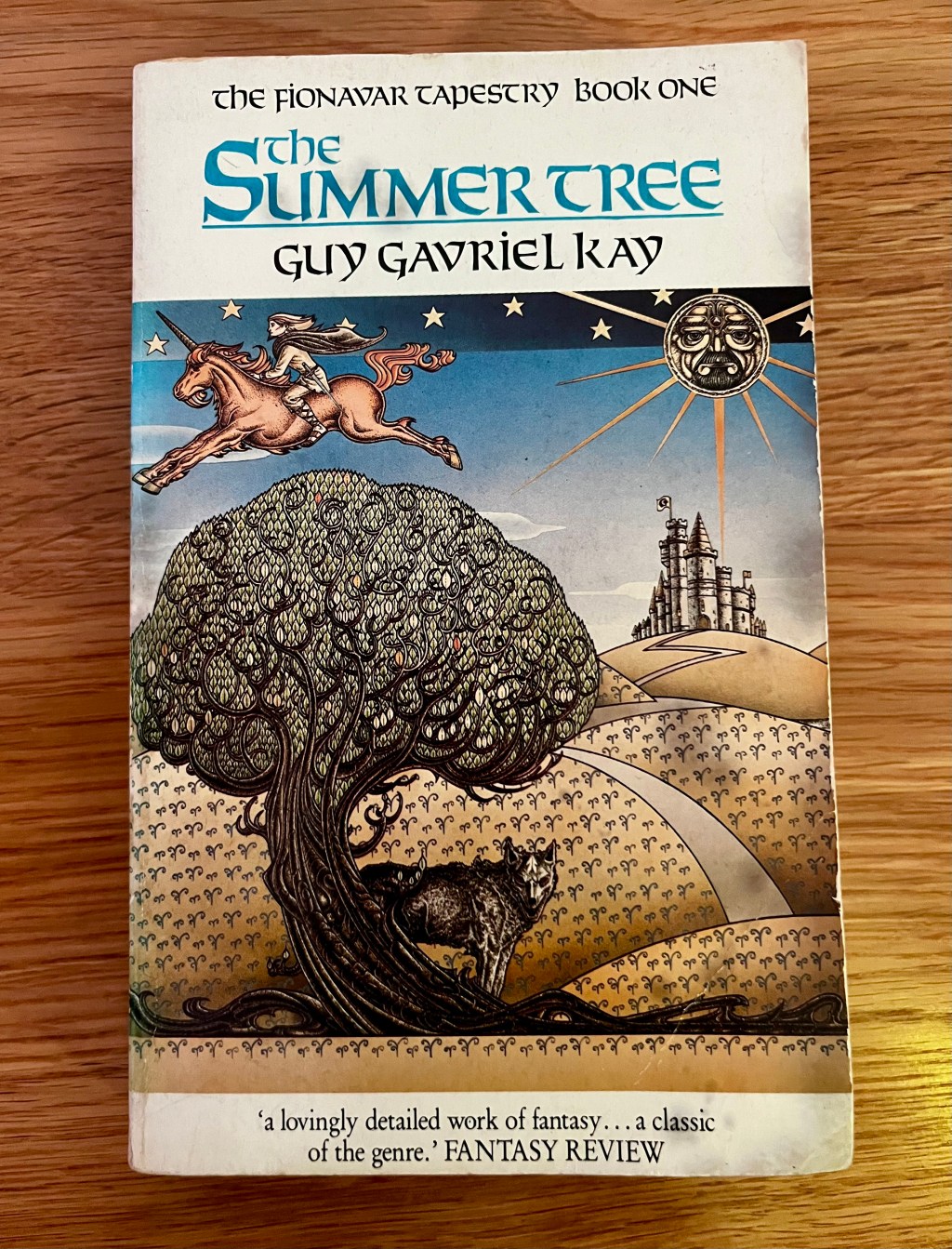
    The Summer Tree, a richly imagined fantasy adventure, is the first of Guy Gavriel Kay’s Fionavar Tapestry trilogy. The novel follows five university students from Toronto who are transported to Fionavar, the ‘first of all worlds’, where they become entangled in an ancient conflict against a dark god breaking free from imprisonment.

    Kay’s worldbuilding is probably the highlight of the novel. The magic system, where mages must be tied to other individuals who serve as ‘sources’ of power, is a nice mechanic. Also nicely done is the imprisonment of dark god Rakoth Maugrim beneath a mountain. The mountain looms visibly in the landscape as a prison in plain sight of all who live there. And the ritual of the Summer Tree itself introduces a compelling concept: kings are traditionally expected to sacrifice themselves during times of crisis, offering their lives to the gods. But they can send others in their place, and this puts one of the protagonists in an interesting position. Throughout, the metaphor of a tapestry and a weaver (symbolising fate and determinism) is contrasted with the dark god—the ‘unweaver’.

    The narrative mostly focuses on its classical fantasy setting—think kings and castles and mages—but it takes a refreshing turn in the final third when we finally reconnect with Dave, the fifth member of the transported group, who went missing during the journey into Fionavar. Kay’s incorporation of Native American-inspired elements here adds a level of cultural diversity to what otherwise might have been a purely European-inspired fantasy setting. The pacing of the story is fine, and the prose is accessible throughout. There’s the odd name you have to remember, but you’re not drowned in unnecessarily complicated language.

    Of the ensemble cast, certain characters stand out with more memorable moments and clear arcs. Paul, driven by grief, finds his place on The Summer Tree; Kevin’s personality comes through. However, this is also where some of the novel’s weaknesses emerge. With five modern-day characters thrust into this fantasy realm, Kay effectively shows different reactions to this strange new world, but this breadth comes at the cost of depth for some characters. We get more substantive development for some protagonists, while others remain relatively undeveloped.

    This imbalance is particularly noticeable in the female characters, both from our world and Fionavar itself. Too often, women in the narrative exist primarily as romantic interests, objects of desire, or victims of violence. In the final pages, there is an instance of sexual assault—unnecessarily graphic as far as I was concerned—as a plot device to show how evil the dark god is. Reading this book forty years after it was first published, it certainly feels dated in this regard.

    Kay has earned comparisons to Tolkien, and not undeservedly so. His own work with Christopher Tolkien in drawing together the stories for the The Silmarillion undoubtedly impacted him, and he has brought to the genre a blend of different mythologies and influences. But I don’t think I was so enamoured by this book that I’d want to continue the trilogy.

  • Book Review: Tress of the Emerald Sea

    Book Review: Tress of the Emerald Sea

    Tress of the Emerald Sea is a wonderful, layered adventure that evolves as the priorities of Tress, our main character, ebb and shift. Tress is a young girl from a barely habitable rock, surrounded by a sea of spores that turn into vines when they touch water. Her friend and love interest, Charlie, the son of the island’s Duke, is sent to the island of the King to be married. When he makes himself completely undesirable, the King sends him to the Midnight Sea (another of several spore seas, each with their own distinct properties) where he is captured by the fearsome Sorceress. 

    Tress, when she finds out, sets off on a grand adventure to save him. On the way, she becomes part of a pirate crew, driven by the fearsome Captain Crow, and meets Fort, Ann, and Salay, as well as Hoid, a world-hopping character of the wider Cosmere who is cursed by the Sorceress. As Tress seeks Charlie, she becomes embroiled in a conflict between the crew and their captain. This multi-tiered adventure keeps the story fresh and engaging. Of the people Tress meets, Ulaam in particular stands out as a delightful character whose presence brings fun and unpredictability to his scenes. An ear on your arm, anyone?

    One of the key strengths of the novel is how its conflicts are solved through different means. Some through combat, sure, but also through wit and quick-thinking. These keep the tension high in the right places, and show Sanderson’s skill in crafting a variety of situations and solutions for his characters. I am a massive fan of different ways of solving problems beyond force—the scene with Xixis the dragon was my favourite—so this scratched a real itch for me.

    The world building, as one would expect of Sanderson, is top-tier. The spores and how they function are cool and varied, and the way they are built into the story is very satisfying. Likewise, the narrative voice, provided by the cursed Hoid (who is rendered to something of a ‘village idiot’ with no fashion sense), connects the novel to the broader Cosmere. Hoid is witty and fun, and this keeps the narrative light. It is also refreshing to have the story told by a third party who is able to comment personally on what is happening without being the centre of the story. I did find some of Hoid’s observations to disrupt the immersion in places—e.g., the reference to ‘laptops’ being a key one. I get that this is supposed to broaden out the links to the world beyond, but, as someone unfamiliar with the rest of the universe, I found it a little jarring.

    Also, Tress’s character development, while clearly central to the story, does sometimes suffer from exposition that I found a little heavy-handed. There are moments when the narrative explicitly states that Tress is changing or growing, even when I think readers can see these changes organically. It’s a little unnecessary and on-the-nose. And, lastly—SPOILERS—certain plot elements create minor inconsistencies that detract from the otherwise cohesive world. For example, the Sorceress has inhabited the planet for years and possesses advanced knowledge of technology that Tress is only beginning to develop. When Tress offers to trade this technology, the Sorceress dismisses it—yet later, her guards are defeated by this very same technology. This inconsistency feels like an oversight that somewhat weakens the internal logic of the story.

    Regardless of some minor flaws, Tress of the Emerald Sea is an easygoing, refreshing sci-fi/fantasy adventure with a cast of loveable characters. The story is accessible and easy to follow, is told with humour, and sits against a well-fleshed-out and intriguing world. It gets a big ‘recommend’ from me!

  • Why Fantasy, Why Now

    Why Fantasy, Why Now

    The world is a little bit on fire right now. Climate change is getting worse. Politics have taken a shift to the right, threatening the rights of historically marginalised peoples. Technology is developing at a rapid pace—creatives are being displaced, jobs are under threat.

    In this world, Fantasy occupies a special place. It offers an escape, yes, but not just escapism—it’s a lens through which we can view and process our reality.

    Firstly, Fantasy gives us the freedom to isolate a problem and task a character with finding a solution. The problem can reflect something we face in our real world. In doing so, the reader is given the opportunity to consider the solution space. With our protagonists, we explore what the various options are.

    From Frodo in The Lord of the Rings to Vin in Mistborn, our heroes are challenged to take on evil and oppression. They try different ways to solve their problem. They fail, and get back up—this is what keeps them relatable, and the reader cheering them on—until they find something that works. 

    And it isn’t just about finding strength and power: Kvothe in The Name of the Wind shows us how intelligence and wit can be used to fight a struggle against poverty. We seem him struggle at numerous times, and we’re with him as he explores ways to attend the University, despite his background.

    In most stories, in the struggle between good and evil, good (usually) ends up on top. (Not always, but usually!) This gives us hope that the struggles we face will one day be resolved. We also learn the costs associated with different actions, the drawbacks, the mistakes—the things we may want to avoid rather than repeat. Through such works, we learn not just what to do, but what to avoid, and how to think critically about our own world’s challenges.

    Mistborn begins in a world where evil has already won, yet our heroes still find a path toward hope and redemption. Hope emerges here from a seemingly hopeless world. In contrast, Legends & Lattes reveals to us smaller victories, more personal, where an orc warrior who has tired of adventure can find fulfilment in opening a coffee shop (and in the relationships she forges along the way).

    A core aspect of Modern Fantasy is the exploration of oppression and difference, race and culture, sexuality and gender identity. Through Fantasy, people who may not have a voice in our world are given time to speak, to explore their concerns, to be heroes and represent the power to change. Above all, even though many of the creatures and peoples we encounter are not human, Fantasy helps us explore and understand our common humanity, our shared personhood and experience.

    Terry Pratchett’s Guards, Guards! and Men at Arms (and numerous other works, honestly, but I pick these as they’re fresh in my mind!) explores class discrimination and systematic inequality through the members of the City Watch. Here, peoples of different races and backgrounds and genders explore and overcome their differences in ways that are humorous, touching, and sincere. Similarly, the Edge Chronicles presents a world where many creatures (from Banderbears to Sky Pirates) must learn to coexist despite their differences.

    When the world around us gets too much, Fantasy allows us to disappear into a world unlike our own, full of mystery and adventure. But that does not mean we are running away. Like the heroes in our stories, we enter these worlds not to abandon reality, but to return changed and better equipped to face it. The best stories don’t just transport us: they transform us.

    Much of this is, of course, true of Science Fiction as well. Where Fantasy uses far off worlds and systems of magic to explore these issues, Sci-Fi uses far off futures and technological changes. Asimov’s Foundation series explores how civilisations can deal with large-scale crises; through Do Androids Dream of Electric Sheep? we question our humanity in a world of advancing technology; similar questions are raised in Asimov’s Baley—Olivaw series (my favourite being The Naked Sun) where the closing gap between robot and human, and the restructuring of human society around that, is explored.

    From finding solutions to considering mistakes, from giving marginalised peoples a voice to giving us the strength to face our world, literature is powerful. And it’s needed now, more than ever. So tell me, what about you? How have the stories you love changed you or given you strength?

  • Book Review: Legends & Lattes

    Book Review: Legends & Lattes

    High fantasy, low stakes – with a double-shot of coffee.

    After decades of adventuring, Viv the orc barbarian is finally hanging up her sword for good. Now she sets her sights on a new dream – for she plans to open the first coffee shop in the city of Thune. Even though no one there knows what coffee actually is.

    If Viv wants to put the past behind her, she can’t go it alone. And help might arrive from unexpected quarters. Yet old rivals and new stand in the way of success. And Thune’s shady underbelly could make it all too easy for Viv to take up the blade once more.

    But the true reward of the uncharted path is the travellers you meet along the way. Whether bound by ancient magic, delicious pastries or a freshly brewed cup, they may become something deeper than Viv ever could have imagined . . .

    Travis Baldree’s Legends & Lattes is a hit for a reason. Influenced by earlier books that brought elements of daily life into fantasy, notably Terry Pratchett’s works, Baldree revised the genre for the Covid era. At a time where people were kept away from their friends and family, when local meeting places were shut, the idea of a cosy story centred around a coffee shop was the height of escapism.

    The narrative focuses on retiring adventurer Viv, who wants to trade in her sword for a quieter life. She builds her hopes around the Scalvert’s Stone, a magical item that promises to bring a ‘ring of fortune’ around its bearer. But this only draws more trouble…

    The heart of the story is its characters. Viv’s journey is anchored to her relationships, in particular with Tandri. Both are loveable and compelling, and the way they find companionship is nuanced and authentic. Supporting characters Cal, Pendry and Thimble further enrich this, with their distinctive personalities each adding warmth and subtly. (Cal was a particular favourite of mine.)

    Though the book promises ‘high fantasy, low stakes’, there is still much tension in a steadily evolving narrative. The cosy atmosphere is balanced against moments of conflict—with the cosy feeling enhanced in moments of resolution. This is driven mostly by the Scalvert’s Stone, which is surrounded by an air of intrigue and mystery—and riddles that characters struggle to fully make sense of. Quite what its presence means for the shop, and for Viv, and what it means should it disappear, is part of what drives the story forward.

    The most compelling aspect of the novel is its immersive atmosphere. Reading it, you almost feel as if you are there, smelling the coffee, tasting Thimble’s cooking, hearing Pendry’s music. It made me really want to just sit down with a coffee and pastry, with a bit of a frost and a chill outside and a nice warming mug of something hot.

    And, at the end of the day, that’s just what reading this book feels like. A nice, warming mug of something hot!

  • Book Review: Thornhedge

    Book Review: Thornhedge

    There’s a princess trapped in a tower. This isn’t her story.

    Meet Toadling. On the day of her birth, she was stolen from her family by the fairies, but she grew up safe and loved in the warm waters of faerieland. Once an adult though, the fae ask a favor of Toadling: return to the human world and offer a blessing of protection to a newborn child. Simple, right?

    If only.

    Centuries later, a knight approaches a towering wall of brambles, where the thorns are as thick as your arm and as sharp as swords. He’s heard there’s a curse here that needs breaking, but it’s a curse Toadling will do anything to uphold…

    Thornhedge by T. Kingfisher is a beautiful novella that both honours and subverts traditional fairy tales: This is, after all, not a story about the princess in the tower!

    One of the most striking aspects of the novella for me was the writing style. Kingfisher has a way of writing where the words seem strange and unusual together, but they’re formed in such a way that help you understand what the characters are feeling. Even something like this:

    She would never be able to describe the ride. No one ever asked her, but she would have liked to have the words to fit around it, if only for herself. It was like a dream that went on for many hours, and in the morning the fragments still lay dusted across her shoulders.

    It just reminds me why I love reading. When done well, writing is such a beautiful art form.

    The magic system is well crafted—simple, but effective, and aesthetically very pleasing. Toadling, the main character, is able to draw on the water around her, and that gives the magic a ‘wetness’, which lends itself well to analogies:

    The drops became a stream, became a torrent, and then Toadling was swimming in the magic, surrounded by it.

    The novel’s structure is equally sophisticated. We move between past and present with a growing urgency. As the narrative progresses, these switches happen more quickly as the book goes on, with the backstory and current events drawing closer together until they finally meet.

    And, of course, at the heart of the story are its characters, Toadling and Halim. Toadling in particular is irresistible. Her quirks and imperfections only make her more endearing. She forms a relationship with the self-deprecating and overly apologetic Halim in a way that feels natural and authentic.

    Together these elements combine in a way that feels fresh in a space so heavily saturated—fairy tales and fae are, of course, long-written and well-read genres. But I think even seasoned readers will find something new in this novella. It is a short read that will stay with you for long after you finish.

  • Book Review: Caraway of the Sea

    Book Review: Caraway of the Sea

    Caraway Auclair has devoted herself to protecting her brother, serving as the ship’s first mate and enforcer. Sacrificing nearly all she is to ensure that he becomes the most fearsome pirate Captain to ever sail the Carnelian Sea. She realizes too late, that the seas have only grown darker, and the waves more fearsome, they threaten to pull her under completely and mold her into something akin to a nightmare.

    Caraway of the Sea, a new novel by Madeline Burget, is a welcome entry to the pirate fantasy/romance space. Billed as a ‘grim cozy pirate tale’, it promises slow-burn romance and lots of paranoia.

    And boy does it deliver.

    Caraway, our titular main character, is a young woman in a man’s world. Here, though she did hide herself as a man in events prior to the story, hiding as a man isn’t the main focus. People accept that she is a woman. But, that does not mean she is free from danger—far from it. Indeed, she is still the subject of violence, and in particular sexual violence. This is explored in some depth.

    But Caraway is herself violent, and we get the sense that this is in some part because she is a woman. To keep herself safe, she has to present herself as someone not to be messed with. And this leads to many a brutal encounter. The action sequences are, indeed, brutal, and bloodthirsty readers will find enough swordplay and gore to satisfy. 

    The main focus is on Caraway’s fracturing relationship with her brother. He, as captain of their crew, is becoming increasingly paranoid and insecure, and she, as his protector, tries to prevent him from following a deadly and ruinous path. But events soon turn for the worse as she becomes the latest subject of his dark suspicions. 

    The story is interspersed with flashbacks, and this mostly works well, though there is one jarring revelation (which I won’t spoil) that made me question how it could take so long for Caraway to come to her eventual realisation. On reflection, it does speak to the nature of gaslighting and abuse in a fundamental way, and made me reevaluate Caraway as something of an unreliable narrator—she is slow to understand what becomes plain to the reader, and we watch her come around.

    My one gripe is the overuse of Caraway recalling memories of things recently passed that the reader was not privy to. The emotional weight of such moments is underwhelming if we weren’t witness to the initial occurrence. This happens more at the start, and is in no way disruptive, but it is just one of those things that didn’t work for me. Perhaps things could have been sequenced differently, or some scenes added in place of others, that would have provided more coherence here.

    Above all, the slow burn romance is done well. Enzo, the strong and handsome love interest, is a compelling counterpoint to Caraway, and his affection for her grows even as she is slow to understand her feelings towards him. We can empathise with her reluctance while still rooting for them—even if Enzo isn’t always trustworthy.

    In all, this book is definitely a worthy contribution to the genre. And, it is the first in a series—I will be interested to see where Caraway adventures next…

  • Book Review: Impossible Creatures

    Book Review: Impossible Creatures

    Impossible Creatures is the latest fantasy novel by Katherine Rundell. It follows Christopher, a boy with a special connection to animals, and Mal, a girl with the unusual ability to fly using a special coat, as they try to stop the glimourie (magic) fading from the Archipelago. The Archipelago is, simply, a collection of islands hidden by magic in the Atlantic Ocean that is home to all sorts of mystical and magical creatures—creatures who had been saved there to prevent their extinction.

    But the islands are under threat, and the magic is fading, and so Christopher and Mal set off on a journey to save all the creatures who rely on this magic. They are joined by Nighthand, an alcoholic who was formerly a bodyguard to the Immortal, the protector of magic since lost for a hundred years, and Irian, a scientist who is similarly investigating the afflictions affecting the creatures.

    It is a wild seafaring adventure that takes the reader to far off places, and we meet, as the title promises, a whole host of mythical beasts. Each has their own personality, their own tendencies, and they are a real joy to behold. I love the creatures—they are the heart and soul of this book. They are present on the island because they were, at some point in history, saved from extinction at human hands. It is curious that other (non-mythical) creatures who became extinct in the years since did not make it on. It would have been nice to encounter a dodo or two. Oh well. Jacques the tiny dragon more than makes up for it.

    The story flows nicely, though there are a few convenient moments were information is handed to the characters just at the right time. We have, at one point, a wealthy women flying about the islands on a longma to places otherwise inaccessible to the protagonists and gathering information for them. At another point, a manticore begins, without being prompted, monologuing on a topic that the characters could conveniently do with some more information about. All this is to keep the story moving at a good, consistent pace, but it does pull the reader out a bit.

    But otherwise, it is a magical and enjoyable read. I liked the ending, which was heart-breaking and inspiring all at once. The antagonist, who we don’t meet until the end, is set well in the broader lore of the island, so it still feels like a good payoff when we meet. And, above all, the bond that forms between Christopher and Mal is a treasure.

  • Book Review: The Plight of the Guardians

    Book Review: The Plight of the Guardians

    This book is the latest in Alonna William’s instalments of the Fables from Wyanidus Lystria series. It takes us on a journey of a changing of the guard, so to speak, of the Guardians, the powerful beings entrusted by the island to look after the weather, over the people, and generally maintain good order. Our heroes are Azari’ah and Ariad’na, who we follow as they turn from rivals into lovers, rise to become guardians, and help solve the island’s problems.

    The relationship between Azari’ah and Ariad’na is the beating heart of this book, and their relationship as it shifts and changes over time drives the plot forward. When they meet, Azari’ah, serious and studious, resents Ariad’na’s careful and playful attitude; Ariad’na, for her part finds Azari’ah’s joylessness off-putting. But when they are forced into proximity by the current guardians, who are training them up, they start to become close. Very close. This yields its own problems, as guardians are forbidden from forming attachments with specific people, lest it bias their judgement. The interplay between the two is great, and I love the dialogue and characterisation.

    In exploring its plot and relationships, the author delves into some hard-hitting themes. She explores issues of poverty and childhood trauma, and the impact this has on later relationships and values. She also digs into themes of toxic masculinity in a way that I think is really well done. Throughout the book, Azari’ah is told by his mentor to be strong and suppress his emotions, to let go of his attachments to people, to be ruled by strict logic. But we see the damage that this has on his psyche, and the struggles it pushes him through.

    The broader world is luscious and expansive. The author clearly has so much care for this land she has created, and that really shines through. All the different creatures, the magic of the island, the interplay of how they all connect—it’s enchanting! It’s a world where, after I put down the book, I can’t wait to get stuck back in.

  • Book Review: The Siren’s Call

    Book Review: The Siren’s Call

    Have you ever woken up one morning to find your hair has turned long and luscious, and your ears pointed? If so, you just might be a siren! This is the fate that befalls Trevor when he starts to go through the equivalent of siren puberty in The Siren’s Call, which leads him on a perilous journey of self discovery and adventure.

    There is much to love about this charming novel. It is rich in carefully crafted maritime mythology, drawing on a range of Atlantic and Mediterranean influences. The world the sirens and other mercreatures inhabit is beautiful and expansive, and we get the pleasure of exploring it more as the story unfolds. The pacing is pleasant, and there are some likeable and engaging characters—Nicholas in particular I found to be interesting. Bloo is another, who has a distinctive and charming pattern of speech.

    That said, the reader might be overwhelmed by just how many characters there are. There are a couple of large families, human and siren, plus a couple of friendship groups we meet along the way. The geography is also a little confusing at the start. The initial setting is late eighteenth century Manchester, UK, though there are frequent movements between the city and the sea.

    Nevertheless, this is a compelling and creative work full of mystery and excitement that it is easy to get drawn into. I love the world, and I am eager to explore the author’s other novels to find out more about it!

  • Book Review: Mad Kestrel

    Book Review: Mad Kestrel

    I am a real sucker for a pirate novel. Throw some magic in there, and you’ve got me. One of my favourite books of all time is On Stranger Tides; one of my favourite movies is Pirates of the Caribbean. I’m not sure if this means my bar is set very high (I’ve read a lot of books about pirates) or very low (I’ll enjoy almost any book that has pirates in).

    Mad Kestrel, by Misty Massey, I thought was a very enjoyable read. Again, I’m late to the party—the book was released in 2008. But I’ve only just found it in my local charity shop. Sue me. It’s a thrilling adventure with a compelling female lead. There are some wonderful action sequences and pulse-raising swordplay. And, of course, some sailing through rough waters (literally and figuratively), and intriguingly handsome—but also infuriatingly charming—men.

    We follow Kestrel, a quartermaster aboard the Wolfsbane, as she attempts to rescue her captured mentor, Artemus Binns. Along the way she meets Phillip McAvery, a smooth-talking rogue who we don’t know whether or not to trust, and we are accompanied by a loyal, hard-working crew… or are we? Throughout, we are trailed by bounty hunters and a mysterious magical order, whose ceaseless pursuit keeps Kestrel constantly on her toes.

    The magic system is probably the weakest part of the book. It’s used to drive the threat more than anything—the protagonist, a special kind of magic wielder, is afraid to use her magic lest she is found by magic hunters. So, we don’t really get to see how it works until the end. And, in the end, it seems almost anything is possible with magic. Because we haven’t really been exposed to it much throughout the book, it means the payoff isn’t all that great. Oh well: Less magic means more room for swords and swashbuckling! And the sword fights and action sequences are superb.

    One thing though: I was disappointed with the author’s choice for the ending…

    SPOILER ALERT!

    The protagonist, Kestrel, is presented with a choice to take her mentor’s place as privateer for the king, or to go about her merry way as a pirate. We’ve had a whole book building up this character as a strong, independent woman who is fighting to prove her place as a leader of men; but in the end, she chooses to be under the thumb of the king. We’re told she negotiated better terms, and women are now allowed to sail on ships in the kingdom (yay!), but it feels a little flat after all that’s happened. I’d have liked for her to stick it to her (male) mentor and the king, and go off pirating into the sunset. But I can understand why the author went the other way… it certainly feels neater, and ties everything up.

    Despite some flaws, this is an enjoyable read, with thrilling adventure and strong characters. I’ll add it to the list of books I’ll recommend to anyone who dares ask me pirate stories!