Tag: fantasy literature

  • Book Review: Shadow of the Gods

    Book Review: Shadow of the Gods

    I’m not sure I was ready to read Shadow of the Gods… It is a brutal, violent dark fantasy. The start of John Gwynne’s Bloodsworn Saga, it journeys through three different perspectives, with characters traversing a world left bloody and divided in the wake of fallen gods.

    The combat sequences are visceral and expertly crafted. Every fight scene is choreographed with brutal precision, from the intimate duels to the massive battles, each one weighted with consequence. The gore—gore that I was not fully prepared for—raises the stakes and makes every confrontation feel genuinely dangerous.

    I had some issues with the three different perspectives. They had strong thematic coherence—overall, Shadow of the Gods is an intertwined story of family bonds and revenge. But I found Orka and Varg’s storylines to be much more interesting, and the characters more compelling, than Elvar’s. It put me in that uncomfortable position where (and I don’t like feeling this) I felt I was waiting for her parts to be over so I could go back to the other perspectives. It’s only in the final act that Elvar’s storyline finally started to engage me.

    What I loved was the worldbuilding. It is built on the same mythological foundation as Skyrim, and that gave me a certain sense of nostalgia. The echo of the dead gods and the impact it has on the characters (in particular the ‘tainted’) drives the story, making it feel truly epic in scope. The magic system integrates well into this world, providing moments of genuine wonder and power.

    On balance, the atmosphere and immersive worldbuilding overcome what I personally felt were structural weaknesses in combining the different storylines. But I admit that I may be in the minority in feeling this. And I certainly feel driven to keep going with the series!

  • Book Review: Equal Rites

    Book Review: Equal Rites

    Terry Pratchett’s Equal Rites is a fun blend of fantasy and social commentary. It is told through the story of Eskarina Smith (known as Esk), a girl who accidentally inherits wizard magic in a world that insists women can only be witches.

    The characters are the book’s greatest strength. Esk is wonderfully ambitious, relentlessly driving the story forward with her determination to become a wizard. Granny Weatherwax is magnificently assertive and dominant—a true force of nature. Even Simon, the awkward young wizard, is delightfully written with genuine charm. All three develop beautifully throughout the story, their growth feeling organic rather than forced.

    Pratchett’s magic system lavishes the world with superb chaotic energy. The way magic literally seeks to escape from books, how the very walls of the Unseen University absorb magical energy and gain sentience—these details create a world where magic feels truly wild and dangerous… and real! The characters must navigate not just social obstacles but a fundamentally unstable magical environment that adds genuine tension to their journey.

    Perhaps most fascinating is Pratchett’s exploration of competing magical philosophies. Witch magic—practical, intuitive, and grounded in real-world problems—stands in sharp contrast to wizard magic, which is academic, hierarchical, and theoretical. This isn’t just for flavour; the genuine debates about different ways of knowing and learning that arise form a core part of the plot.

    Building on this, the satire of Unseen University spears traditional academic establishments everywhere (as someone who has worked in that environment, you can recognise some of the characters!). Pratchett sets focus on the politics, traditions, and resistance to change that plague many institutions. Indeed, there is an inherent contradiction between the University’s self-importance and its actual dysfunction that encapsulates the book’s themes.

    The story itself succeeds despite—or perhaps because of—its straightforward allegory. Yes, the gender dynamics critique is fairly obvious and somewhat on the nose, but Pratchett grounds it in genuine character motivations and real stakes. And to this day it remains eminently readable and relatable.

  • Why Fantasy, Why Now

    Why Fantasy, Why Now

    The world is a little bit on fire right now. Climate change is getting worse. Politics have taken a shift to the right, threatening the rights of historically marginalised peoples. Technology is developing at a rapid pace—creatives are being displaced, jobs are under threat.

    In this world, Fantasy occupies a special place. It offers an escape, yes, but not just escapism—it’s a lens through which we can view and process our reality.

    Firstly, Fantasy gives us the freedom to isolate a problem and task a character with finding a solution. The problem can reflect something we face in our real world. In doing so, the reader is given the opportunity to consider the solution space. With our protagonists, we explore what the various options are.

    From Frodo in The Lord of the Rings to Vin in Mistborn, our heroes are challenged to take on evil and oppression. They try different ways to solve their problem. They fail, and get back up—this is what keeps them relatable, and the reader cheering them on—until they find something that works. 

    And it isn’t just about finding strength and power: Kvothe in The Name of the Wind shows us how intelligence and wit can be used to fight a struggle against poverty. We seem him struggle at numerous times, and we’re with him as he explores ways to attend the University, despite his background.

    In most stories, in the struggle between good and evil, good (usually) ends up on top. (Not always, but usually!) This gives us hope that the struggles we face will one day be resolved. We also learn the costs associated with different actions, the drawbacks, the mistakes—the things we may want to avoid rather than repeat. Through such works, we learn not just what to do, but what to avoid, and how to think critically about our own world’s challenges.

    Mistborn begins in a world where evil has already won, yet our heroes still find a path toward hope and redemption. Hope emerges here from a seemingly hopeless world. In contrast, Legends & Lattes reveals to us smaller victories, more personal, where an orc warrior who has tired of adventure can find fulfilment in opening a coffee shop (and in the relationships she forges along the way).

    A core aspect of Modern Fantasy is the exploration of oppression and difference, race and culture, sexuality and gender identity. Through Fantasy, people who may not have a voice in our world are given time to speak, to explore their concerns, to be heroes and represent the power to change. Above all, even though many of the creatures and peoples we encounter are not human, Fantasy helps us explore and understand our common humanity, our shared personhood and experience.

    Terry Pratchett’s Guards, Guards! and Men at Arms (and numerous other works, honestly, but I pick these as they’re fresh in my mind!) explores class discrimination and systematic inequality through the members of the City Watch. Here, peoples of different races and backgrounds and genders explore and overcome their differences in ways that are humorous, touching, and sincere. Similarly, the Edge Chronicles presents a world where many creatures (from Banderbears to Sky Pirates) must learn to coexist despite their differences.

    When the world around us gets too much, Fantasy allows us to disappear into a world unlike our own, full of mystery and adventure. But that does not mean we are running away. Like the heroes in our stories, we enter these worlds not to abandon reality, but to return changed and better equipped to face it. The best stories don’t just transport us: they transform us.

    Much of this is, of course, true of Science Fiction as well. Where Fantasy uses far off worlds and systems of magic to explore these issues, Sci-Fi uses far off futures and technological changes. Asimov’s Foundation series explores how civilisations can deal with large-scale crises; through Do Androids Dream of Electric Sheep? we question our humanity in a world of advancing technology; similar questions are raised in Asimov’s Baley—Olivaw series (my favourite being The Naked Sun) where the closing gap between robot and human, and the restructuring of human society around that, is explored.

    From finding solutions to considering mistakes, from giving marginalised peoples a voice to giving us the strength to face our world, literature is powerful. And it’s needed now, more than ever. So tell me, what about you? How have the stories you love changed you or given you strength?

  • Book Review: Legends & Lattes

    Book Review: Legends & Lattes

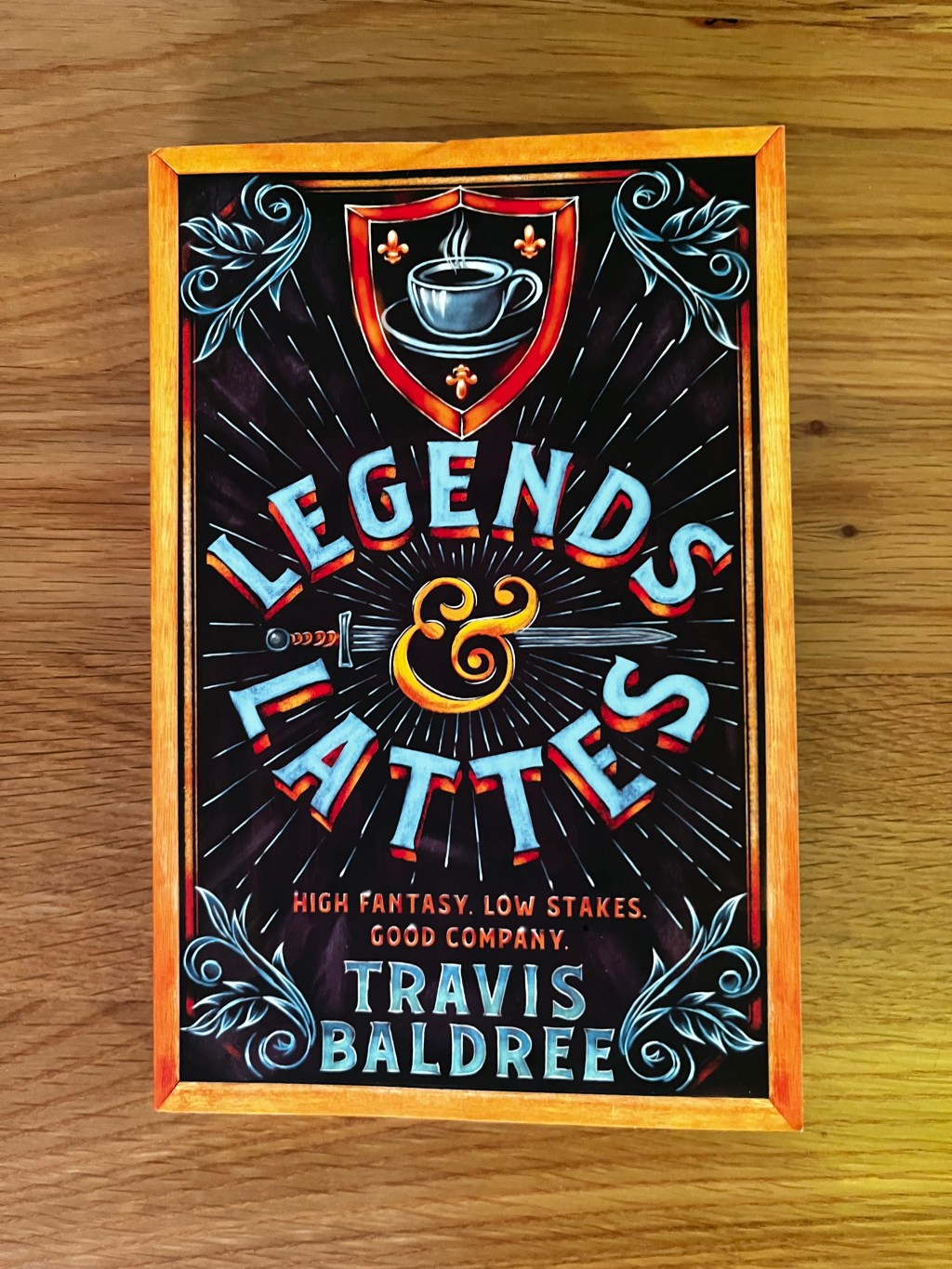
    High fantasy, low stakes – with a double-shot of coffee.

    After decades of adventuring, Viv the orc barbarian is finally hanging up her sword for good. Now she sets her sights on a new dream – for she plans to open the first coffee shop in the city of Thune. Even though no one there knows what coffee actually is.

    If Viv wants to put the past behind her, she can’t go it alone. And help might arrive from unexpected quarters. Yet old rivals and new stand in the way of success. And Thune’s shady underbelly could make it all too easy for Viv to take up the blade once more.

    But the true reward of the uncharted path is the travellers you meet along the way. Whether bound by ancient magic, delicious pastries or a freshly brewed cup, they may become something deeper than Viv ever could have imagined . . .

    Travis Baldree’s Legends & Lattes is a hit for a reason. Influenced by earlier books that brought elements of daily life into fantasy, notably Terry Pratchett’s works, Baldree revised the genre for the Covid era. At a time where people were kept away from their friends and family, when local meeting places were shut, the idea of a cosy story centred around a coffee shop was the height of escapism.

    The narrative focuses on retiring adventurer Viv, who wants to trade in her sword for a quieter life. She builds her hopes around the Scalvert’s Stone, a magical item that promises to bring a ‘ring of fortune’ around its bearer. But this only draws more trouble…

    The heart of the story is its characters. Viv’s journey is anchored to her relationships, in particular with Tandri. Both are loveable and compelling, and the way they find companionship is nuanced and authentic. Supporting characters Cal, Pendry and Thimble further enrich this, with their distinctive personalities each adding warmth and subtly. (Cal was a particular favourite of mine.)

    Though the book promises ‘high fantasy, low stakes’, there is still much tension in a steadily evolving narrative. The cosy atmosphere is balanced against moments of conflict—with the cosy feeling enhanced in moments of resolution. This is driven mostly by the Scalvert’s Stone, which is surrounded by an air of intrigue and mystery—and riddles that characters struggle to fully make sense of. Quite what its presence means for the shop, and for Viv, and what it means should it disappear, is part of what drives the story forward.

    The most compelling aspect of the novel is its immersive atmosphere. Reading it, you almost feel as if you are there, smelling the coffee, tasting Thimble’s cooking, hearing Pendry’s music. It made me really want to just sit down with a coffee and pastry, with a bit of a frost and a chill outside and a nice warming mug of something hot.

    And, at the end of the day, that’s just what reading this book feels like. A nice, warming mug of something hot!