Tag: fantasy books

  • Book Review: Godkiller

    Book Review: Godkiller

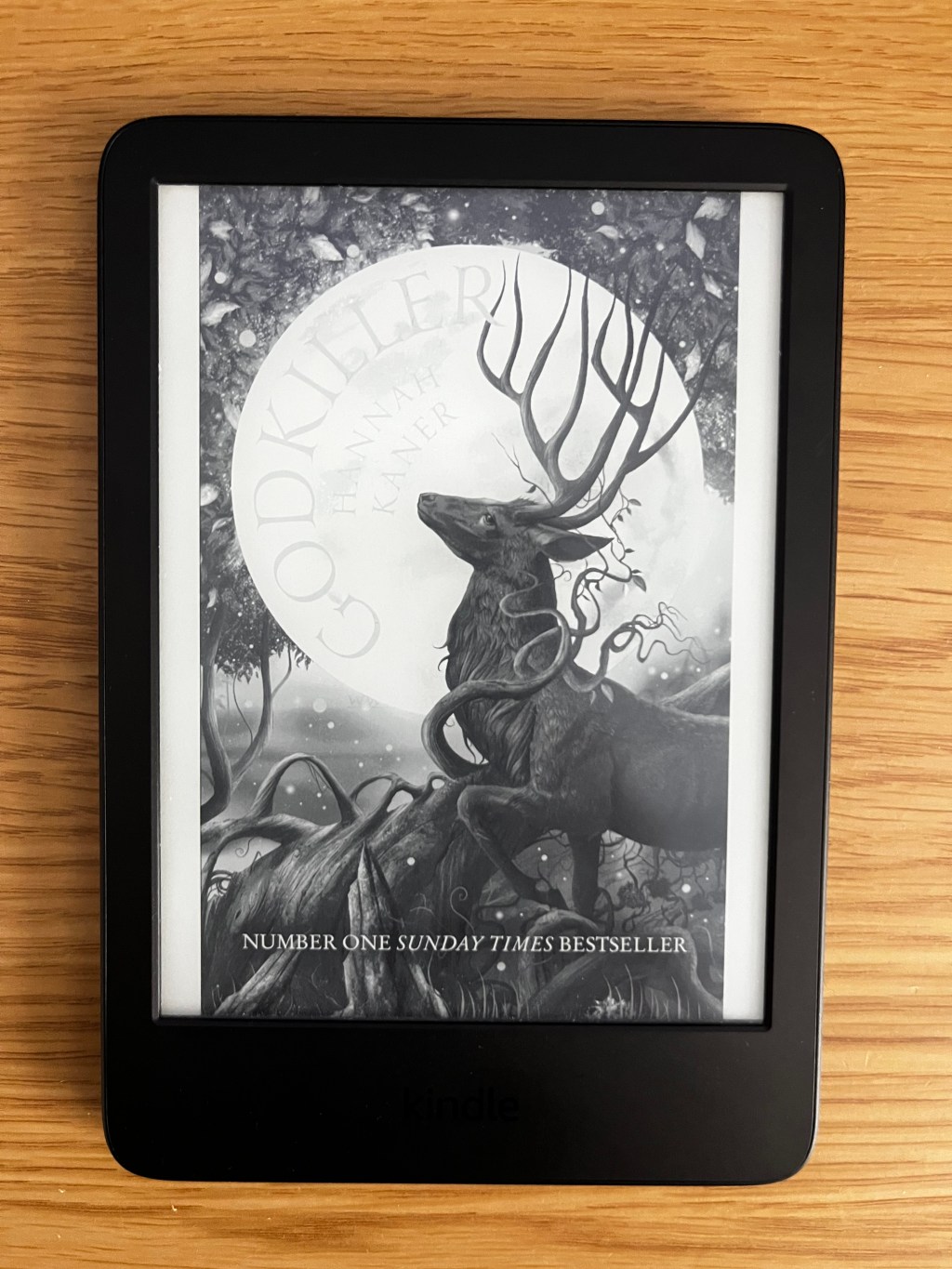
    Kissen’s family were killed by zealots of a fire god. Now, she makes a living killing gods, and enjoys it. That is until she finds a god she cannot kill: Skedi, a god of white lies, has somehow bound himself to a young noble, and they are both on the run from unknown assassins.

    What immediately drew me in to Hannah Kaner’s Godkiller was the way she conceptualises the gods. In this world, gods are born from human belief and need. The more people worship them, the stronger they become. It’s both simple and complex in how it works, with a symbiotic system that creates genuine stakes for both mortals and deities. It was interesting to explore how this dynamic shaped everything from village politics to divine hierarchies.

    The relationship between Kissen (the godkiller herself) and young Inara, the young noble tied to Skedi, anchors the story well. Their unlikely partnership (the woman who destroys gods paired with a girl who might be tied to one) creates natural tension. Watching their bond develop as they navigate this dangerous world together was another highlight of the book.

    The prose is the kind of prose that gets the job done, and the dialogue serves its purpose. In a sense it’s good that the writing doesn’t get in the way of the story (that can be an issue with some books where writers can be a little self-indulgent with their flare!). But I could have done with maybe a little more imagery and metaphor to bring the scenes to life.

    That being said, the story is well structured. The pacing doesn’t drag and the plot progression feels logical and well thought out. Each revelation builds naturally on what came before, and I never felt lost or confused about the world’s rules or the characters’ motivations.

    And the worldbuilding really is Godkiller’s strongest suit. Beyond just the god creation concept, Godkiller has a setting that feels authentic. The political tensions, the way different regions handle their divine relationships, the consequences of godkilling, it all hangs together convincingly. This was enough to make it an enjoyable read.

  • Book Review: The Colour of Magic

    Book Review: The Colour of Magic

    The Colour of Magic introduces readers to Terry Pratchett’s Discworld—a flat planet balanced on the backs of four elephants standing on a giant turtle swimming through space. The story follows Rincewind, a wizard capable of performing only one spell, who reluctantly becomes the guide for Twoflower, the Disc’s first tourist, complete with his magical luggage that follows him on hundreds of tiny legs. Their misadventures take them across the Disc as they flee assassins, dragons, and the whims of gods.

    What I loved most was the dynamic between Rincewind and Twoflower. It strikes a perfect balance between the cynical wizard and the wide-eyed tourist, creating a classic contrast of worldviews. I loved the interplay here—Rincewind desperate to avoid adventure, Twoflower open to exploring and nonchalant about the consequences.

    The prose is great; I’ve heard some people say that they’re not so keen on Pratchett’s earlier work and it takes him a few books to hone his style, but even still I really like it. What I think is key is his ability to imply rather than explain. He often shows reactions or outcomes, trusting readers to fill in what happened. It misfires from time to time (occasionally I misinterpret what happens), but this  is rare, and on balance I find it really effective.

    The four-part structure of The Colour of Magic gives the novel an enjoyable episodic quality, allowing us to experience the different corners of Discworld while exploring the interplay between gods and the fundamentals of magic. We move through different parts of the world, visiting Ankh-Morpork, then woods and temples, dragons, to the very edge of the Disc, in a really fun and varied way. 

    And, at its core, we get this really loving satire and parody of fantasy tropes. This is what makes Pratchett’s work distinctive—there’s an affectionate mockery of a genre he clearly adores, in this case some of the classic sword and sorcery works. All this as part of fantastic and rich world building that incorporates modernist themes, religion, bureaucracy, and other carefully selected and well represented targets of gentle mockery.

    My only criticism lies in the transition between the third and final parts, where it felt like something significant occurred off-page. There was a momentary disconnect for me that was more jarring than the book’s other scene shifts. But otherwise I loved it, and I love Pratchett, and it’s been a great experience revisiting some of his work.

  • Book Review: Thornhedge

    Book Review: Thornhedge

    There’s a princess trapped in a tower. This isn’t her story.

    Meet Toadling. On the day of her birth, she was stolen from her family by the fairies, but she grew up safe and loved in the warm waters of faerieland. Once an adult though, the fae ask a favor of Toadling: return to the human world and offer a blessing of protection to a newborn child. Simple, right?

    If only.

    Centuries later, a knight approaches a towering wall of brambles, where the thorns are as thick as your arm and as sharp as swords. He’s heard there’s a curse here that needs breaking, but it’s a curse Toadling will do anything to uphold…

    Thornhedge by T. Kingfisher is a beautiful novella that both honours and subverts traditional fairy tales: This is, after all, not a story about the princess in the tower!

    One of the most striking aspects of the novella for me was the writing style. Kingfisher has a way of writing where the words seem strange and unusual together, but they’re formed in such a way that help you understand what the characters are feeling. Even something like this:

    She would never be able to describe the ride. No one ever asked her, but she would have liked to have the words to fit around it, if only for herself. It was like a dream that went on for many hours, and in the morning the fragments still lay dusted across her shoulders.

    It just reminds me why I love reading. When done well, writing is such a beautiful art form.

    The magic system is well crafted—simple, but effective, and aesthetically very pleasing. Toadling, the main character, is able to draw on the water around her, and that gives the magic a ‘wetness’, which lends itself well to analogies:

    The drops became a stream, became a torrent, and then Toadling was swimming in the magic, surrounded by it.

    The novel’s structure is equally sophisticated. We move between past and present with a growing urgency. As the narrative progresses, these switches happen more quickly as the book goes on, with the backstory and current events drawing closer together until they finally meet.

    And, of course, at the heart of the story are its characters, Toadling and Halim. Toadling in particular is irresistible. Her quirks and imperfections only make her more endearing. She forms a relationship with the self-deprecating and overly apologetic Halim in a way that feels natural and authentic.

    Together these elements combine in a way that feels fresh in a space so heavily saturated—fairy tales and fae are, of course, long-written and well-read genres. But I think even seasoned readers will find something new in this novella. It is a short read that will stay with you for long after you finish.