Tag: Comedy

  • Book Review: The Restaurant at the End of the Universe

    Book Review: The Restaurant at the End of the Universe

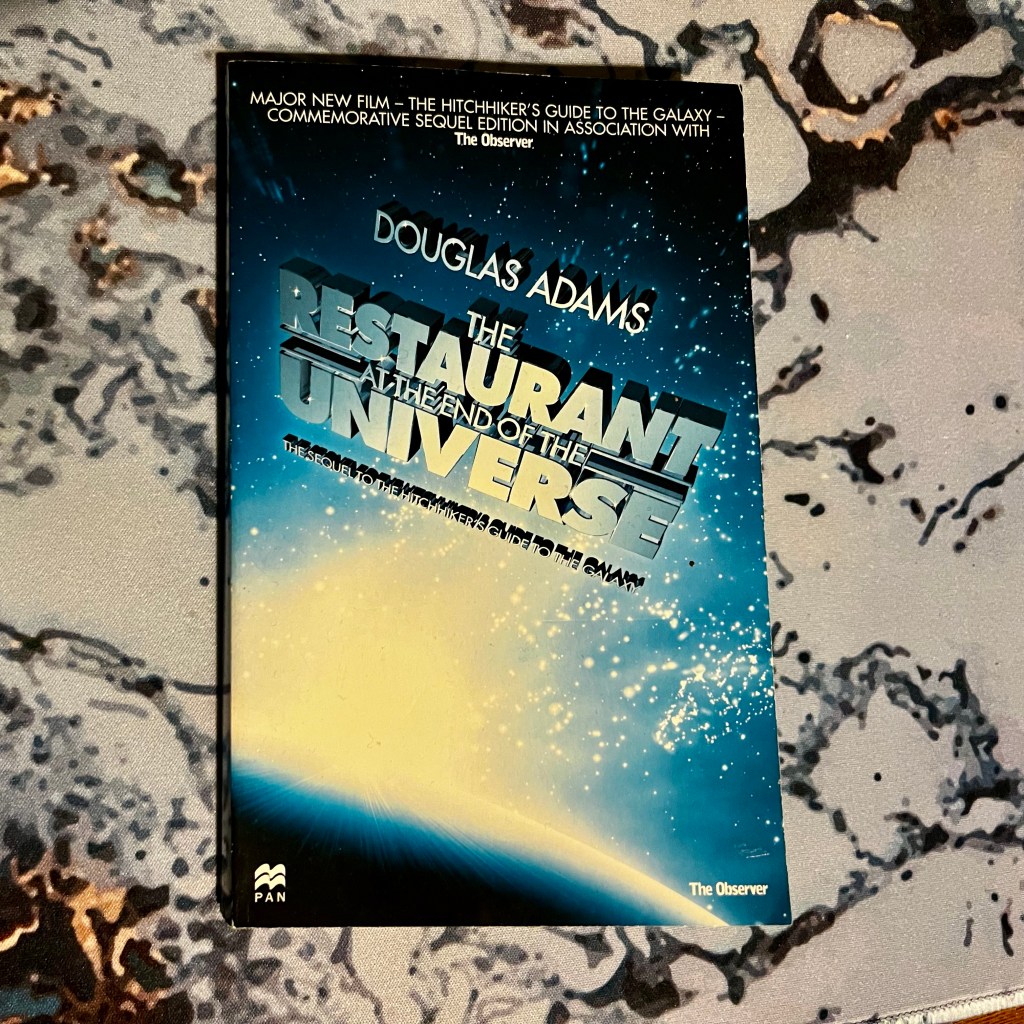
    The Restaurant at the End of the Universe by Douglas Adams is full of the same zany, unpredictable storytelling that made The Hitchhiker’s Guide to the Galaxy such a hit. 

    What I love most about this book is how the book jumps from one impossible situation to another. I had no idea where the story was going to go, and neither did the characters. This is made possible by the technology within Adams’ universe, whether it be teleportation, time travel, or reality manipulation. I think the thing that makes it work as a narrative device is that the stupid, unpredictable situation the characters find themselves in always makes things harder, or worse; they might be rescued from one situation, but find themselves jumping out of the frying pan into the fire. This makes it really effective storytelling.

    I think the character work wasn’t as strong as the preceding novel. Marvin remains one of the best characters in modern literature, and I really enjoyed having large chunks of the story told from Zaphod’s perspective. His journey to meet the ruler of the universe revealed some great backstory. But Arthur, Ford, and Trillian’s storylines were undeveloped and not quite as interesting by comparison.

    The ending was a little flat for me, as well. Zaphod finally meets the ruler of the universe and, [SPOILERS], it turns out he doesn’t have any idea that he’s making decisions that impact the entire universe (a universe the ruler isn’t sure exists). I get the joke Adams is making, but the execution, especially how quickly Zarniworp becomes frustrated, didn’t hit for me. Similarly, Arthur and Ford wandering around prehistoric Earth was a bit of a drag. That said, the revelation of the Ultimate Question was exactly the kind of comic deflation that worked really well.

    I’ve been reading a lot of Terry Pratchett and Douglas Adams recently. I’m still at the starting point of my journey through their respective universes, but I’m finding myself preferring Adams’ humour and writing style at the moment (though don’t get my wrong, both are fantastic). Where Pratchett sometimes breaks the fourth wall with references to our world, Adams creates alien societies that mirror our own absurdities without winking directly at the reader. This makes the satire feel more integrated and immersive.

    So, onwards I journey! Next stop: Life, the Universe and Everything.

  • Book Review: Mort

    Book Review: Mort

    I’m about five or six books into Discworld as a series now, and so I’ve seen Death appear as a minor character a few times. But I was very intrigued to read Mort, which sees the whole story revolve around Death and the titular character, his new apprentice.

    Death wants a holiday, wants to explore his other interests, find out what it means to be alive… and who better to take over his work than a gangly farm boy that no one else wanted as their apprentice?

    Death and Mort act as counterpoints to each other. In his time away from his ‘work’, Death struggles with humanity (trying to get drunk, not really getting why people fear him—except cats, that is). 

    Mort, on the other hand, grapples with the weight of having to sever peoples’ souls from their earthly bodies, and the apparent lack of justice when they die (because, in the end, people go where they believe they’re going to go). 

    They both go through steady arcs, with Death finding peace as a chef, and Mort becoming less bumbling and more able to take on the powers of the job, even as he questions his duty.

    One of the things I loved most was the conceptualisation of time. The instigating moment for the plot was Mort’s refusal to take Princess Keli’s soul, which created an inflection point in time. She should have died, and history carries on as if she did, and eventually it all tries to self-correct. It’s clever writing and creates a set-up where the reader isn’t sure how it’s going to be resolved.

    I found the supporting cast to be hit or miss, though. I liked Ysabel and her relationship with Mort, and how it goes from antagonistic to friendship over time. Albert is an excellent character, especially when his mysterious past is unveiled. But I wasn’t so sure about Cutwell—I’m not sure if he was supposed to be annoying and off-putting, but I wasn’t really keen on him!

    This is a really interesting and unusual fantasy book showing how Pratchett continued to have a unique take on the genre. Like I said, I’m five or six books in, and none of them have really felt the same.

  • Book Review: The Light Fantastic

    Book Review: The Light Fantastic

    The Light Fantastic is a strange, unpredictable book that is subject to its own whims and internal logic.

    So, essentially, exactly what you’d expect from a Terry Pratchett novel.

    It follows on from The Colour of Magic, though with more confidence in the narrative and voice. It overcomes some of the structural hiccups of the previous book, and its full of the beautiful, absurdist humour that we all love about Pratchett. We follow Rincewind and Twoflower as they continue their journey through Discworld on a mission to save it from certain doom.

    There are some really memorable scenes in this book. The computer created by the druids is wonderfully funny (and another great example of Pratchettian satire), as is Rincewind’s voyage into Death’s home to rescue the unperturbed Twoflower. The latter parts of the book, with mobs of increasingly erratic inhabitants of the soon-to-be-destroyed world, are both gripping and hilarious.

    The characters themselves are the heart of the novel. Rincewind and Twoflower are, of course, central, and their opposites-attract-style relationship is timeless. But others, notably Cohen the Barbarian, steal the show. Of Pratchett’s gentle parody at the expense of fantasy tropes, this is one of my favourites.

    At the same time, the plot builds in that uniquely Pratchett way, with a blend of absurdity and genuine stakes. And the ending is surprisingly touching and unexpected, and feels like a natural conclusion to this part of Rincewind’s adventure.

    If you’re looking for a natural entry point to Pratchett’s world, you could do worse than reading The Light Fantastic.