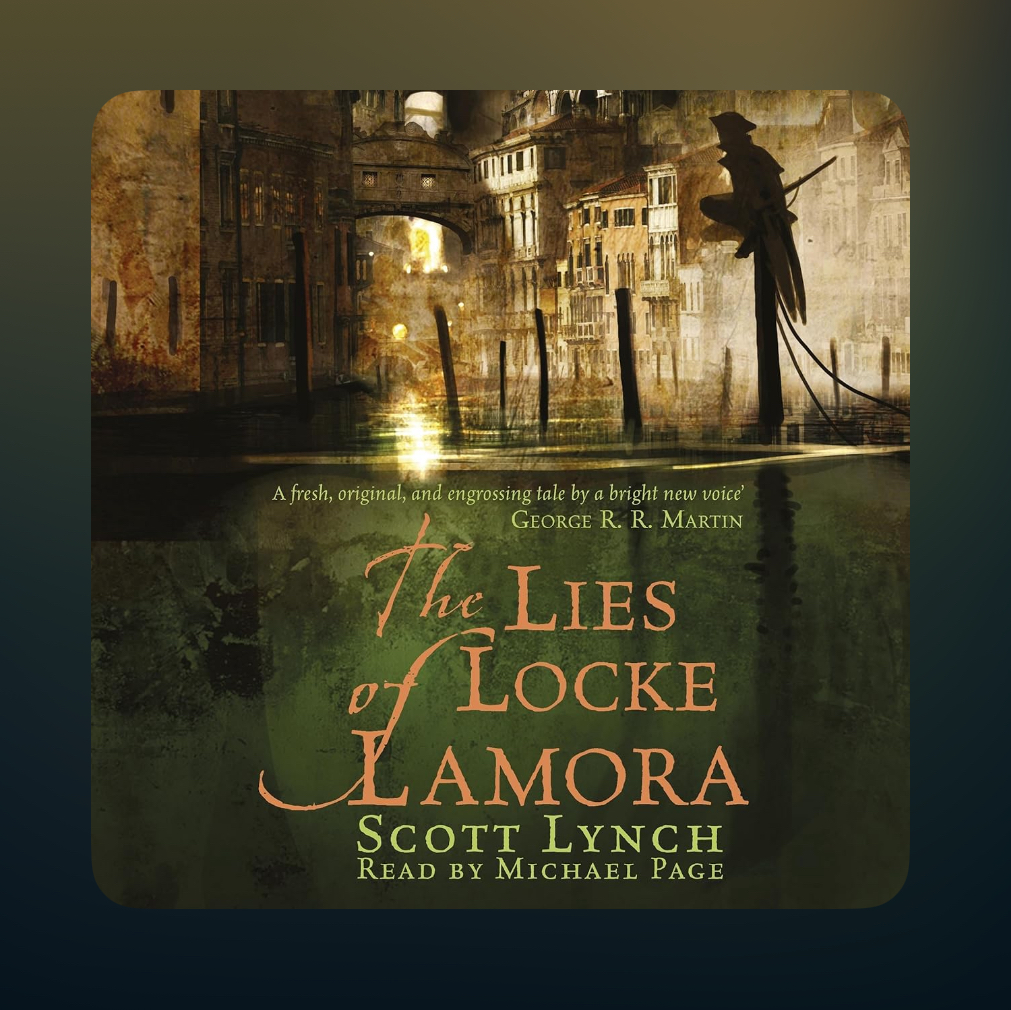
Scott Lynch’s debut fantasy novel, The Lies of Locke Lamora, features an elaborate heist set in a beautifully realised seventeeth-century-inspired world.
Honestly, it hit me in the same way that The Name of the Wind did. We have a physically unimpressive protagonist who makes up for a lack of brawn with guile and pure cunning. Locke Lamora is endearing in the same way the Kvothe is. He executes elaborate cons and talks his way out of deadly situations. He fits the rogue archetype to a tee. And Jean is an excellent companion (and Jean brings the physicality that Locke lacks). He’s not a simpleton or a yes-man in the way that some ‘brawler’ characters can be. He feels well defined in his own right. Above all, their friendship feels genuine and lived in. It’s easy to care about them.
As fantasy heists go, the plot is near perfect. It’s well structured and escalates in just the right way. Just as you think you have a handle on what’s going on, something else happens and it all spirals into some bigger and more dangerous; the stakes are raised organically and plausibly at each turn. And they’re raised in ways I couldn’t see coming. There’s also backstory interwoven throughout (the kind of backstory that again reminded me of The Name of the Wind, albeit delivered in a different way). Information important to the present moment is delivered via these backstories, keeping them timely and relevant.
The worldbuilding is immersive without being overwhelming. None of the protagonists are magic, but they encounter others who are—and so Lynch has to create problems that are challenging for the protagonists, whilst giving them scope to overcome them. I think he strikes the right balance between power and limitation, and the rules are clear enough for some satisfying loopholes to be exploited without feeling contrived.
It’s not without its flaws. There’s hints at a romantic subplot that never quite develops. And [MODERATE SPOILERS] Locke’s heroic turn at the climax didn’t feel completely earned. I understand the choices made, but I didn’t fully buy it. There were also some stretches where plot threads were left unattended, as other parts of the plot moved forward.
But these complaints are relatively minor. I was entertained enough by the characters, the dialogue, and the rich world. It has enough clever problem solving and good character work to scratch the same itch as The Name of the Wind.
 Peter R. S. Thomas