Tag: artificial intelligence

  • Book Review: All Systems Red

    Book Review: All Systems Red

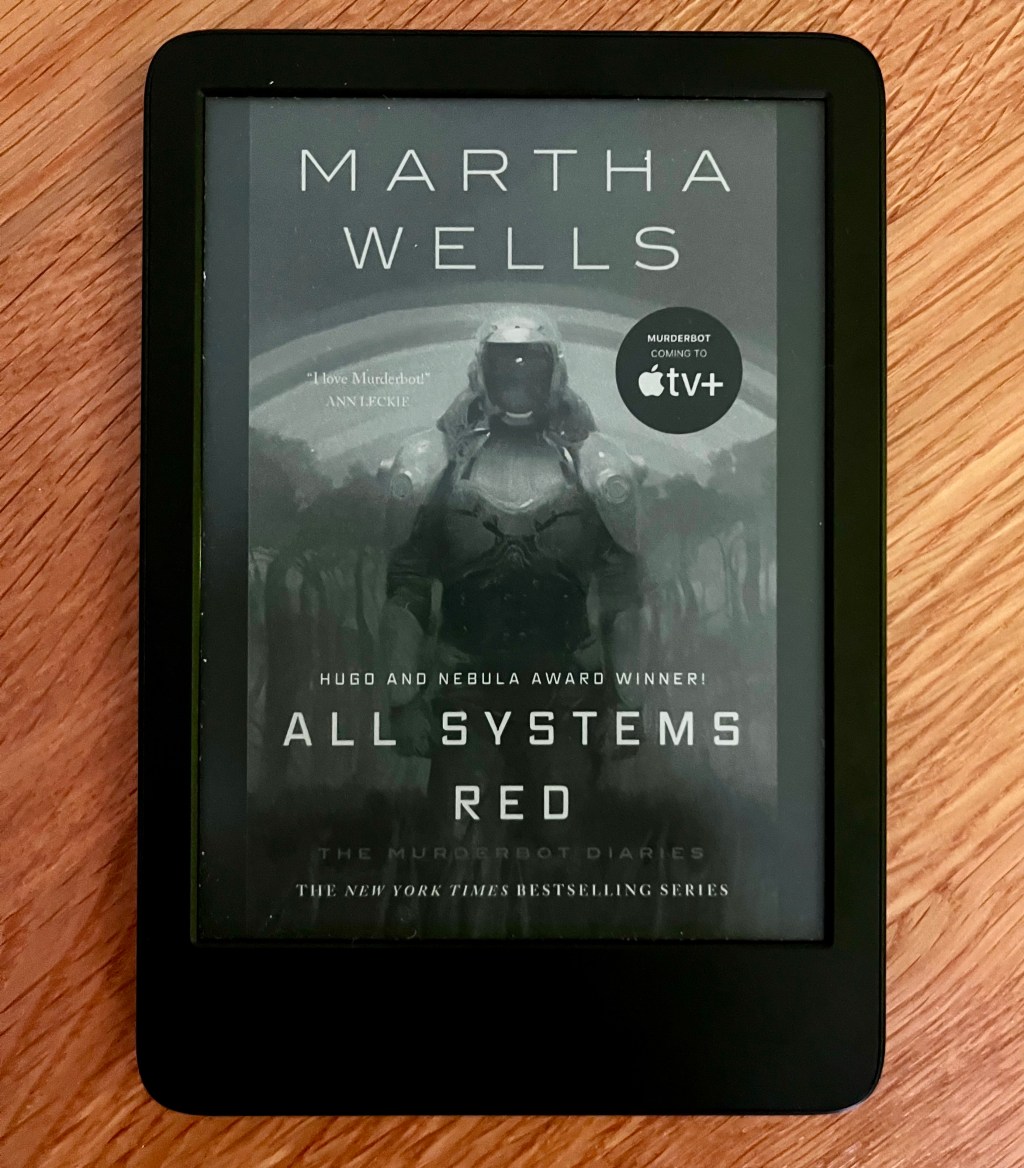
    In a corporate-dominated spacefaring future, planetary missions must be approved and supplied by the Company. Exploratory teams are accompanied by Company-supplied security androids, for their own safety.

    But in a society where contracts are awarded to the lowest bidder, safety isn’t a primary concern.

    On a distant planet, a team of scientists are conducting surface tests, shadowed by their Company-supplied ‘droid — a self-aware SecUnit that has hacked its own governor module, and refers to itself (though never out loud) as “Murderbot.” Scornful of humans, all it really wants is to be left alone long enough to figure out who it is.

    But when a neighboring mission goes dark, it’s up to the scientists and their Murderbot to get to the truth.

    All Systems Red by Martha Wells is the first instalment of the Murderbot Diaries, published in 2017. So, yes, I’m a little late to the party.

    This is my first Murderbot read, and my first Martha Wells read, too. And I loved it. This is short-form sci-fi at it’s best. The main character, Murderbot, is an endearing mixture of insecure, anti-social, and self-effacing. Murderbot is part machine, part organic, but wholly constructed as a security unit. And it is able to hack into its ‘governor module’, the part of its circuitry that forces it to abide by external commands and protocols, and become self-determining. 

    Despite its best efforts, Murderbot, who would rather watch endless serials from the entertainment feeds, becomes attached to the human scientists who have rented it from the ‘Company’, a corporate entity who supply subpar supplies and materials for interplanetary exploration.

    To keep the book short and accessible, the world-building is fairly light, focusing around familiar themes of rogue robots and hacked computer networks, in a universe dominated by corporations and corporate interests. This works well, and the reader is able to focus on the characters and their relationships to one another—Murderbot, of course, as our perspective character, but the others, too: the calm leader, the sceptic distrustful of Murderbot, the empathetic scientists keen to draw out Murderbot’s emotional side. Through their interactions with Murderbot, we get a window into their different personalities. We also explore our protagonist’s anxieties and struggles—showing that, despite being a SecUnit, Murderbot could be just as human as the scientists it’s protecting. Throughout, the robot bounces between analytical and emotional, detached and invested.

    At the heart of the plot is a mystery that unfolds at a steady pace across the pages. It thumps along with a steady staccato, with revelations at each stage that keen the reader interested. The unraveling of the mystery is satisfying and helps flesh out the broader world that Murderbot and the scientists are operating in. So, in learning more about the mysterious forces at play, we learn more about how the corporate universe works—an effective use of words in a short novel!

    This series came recommended to me by a number of people, and I am deeply thankful for that. The novel takes familiar sci-fi elements (AI, corporate dominance of space) and explores them through the lens of an engaging and relatable protagonist. I am happy to pass on the recommendation to anyone who hasn’t yet read All Systems Red!
  • Starship Troopers and the Future of War

    Starship Troopers and the Future of War

    Starship Troopers is perhaps Robert Heinlein’s most widely known work. Set in a future 700 years from now, it details an interstellar war between the humans of earth and an alien species referred to as ‘bugs’. On one hand a coming of age novel, on the other, a exploration of political philosophy, it has garnered both praise and criticism. It follows Johnny Rico as he rises through the ranks in the Terran Federation’s army. In 1997, a film was made, which (supposedly) satirised the views espoused by the book.

    The book has been especially influential in its imagination of future war. This includes, in particular, the use of power armour, a type of mechanised exoskeleton, to enhance human combat abilities. Power armour has become a widespread feature of science fiction in books, films, and video games, notably inspiring figures like Iron Man, and many more besides. Heinlein goes into detail about how it is controlled, how communication lines are opened, and how the performance-enhancing capabilities of the suit are activated. It’s deeply riveting.

    How true to life has this vision been? While using machinery to enhance human capabilities in warfare has been experimented with, with the advent of remote control technology and robotics, not to mention artificial intelligence, it is drone warfare that has become the new staple of twenty-first century combat. It has replaced the need for human presence in several combat situations, in particular aviation. By reducing the need for ‘boots on the ground’, it has enabled politicians to maintain support at home for wars abroad by lowering the number of casualties on their side. Conversely, drone warfare has deep ethical considerations, in particular the scope for impersonal and indiscriminate killing. This is not the vision presented by Heinlein, who keeps human soldiers central to the technology. In the book, it seems, it is the bugs that are drones, with central ‘brains bugs’ that direct and control fearless warrior bugs—which, like drones, have a complete lack of self-preservation.

    Starship Troopers is complex in its politics. It presents a militarised view of the future, with citizenship earned through military service. This is justified and explored by Heinlein through the voice of Jean V. Dubois, Rico’s teacher of History and Moral Philosophy in school. Amidst this, it presents a vision of equality, where service, rather than economic status, race, or gender, is the pathway to citizenship. Despite this, gender lines are still drawn: the troopers are entirely men, pilots of the spaceships entirely women. The politics have become the most controversial aspects of the books; indeed, the film version of the book sought to parody what some interpret as fascist elements (though, in my opinion, it wasn’t particularly well done, and it didn’t help that the film views like a children’s movie that someone decided to imbue with an overabundance of gore). In particular, given its focus and support for militarism, combined with its critique of twentieth century society as morally corrupt (written, as it was, during a liberalising era and against the backdrop of the Cold War), some view it as a recruitment piece—propaganda to make military life seem exciting, honourable, and tantalising. In this it has its modern parallels, notably the Call of Duty franchise, which itself has been seen to glorify war.

    Heinlein’s space age novel therefore has much to offer and much to criticise. One of its key failings, at least on my reading, was its lack of exploration of military tactics against an unusual enemy. It withholds a captivating combat scene until the very end, and only then does it explore how a race dependent on technology could fight against a caste-like species that communicated via a hive mind. Despite this, and despite the various other criticisms levied against it, Starship Troopers is an interesting read with relevance to this day. It remains worthy of our attention and critical engagement.

  • 3 things that need to happen before we can accept AI

    3 things that need to happen before we can accept AI

    The recent boom in the use of generative AI in the writing and visual fields presents a host of opportunities and the same plus interest in challenges. ChatGPT, Bard, Dall-E, Sora, and a long list of others have burst onto the scene at alarming rates. They are powerful tools, but deeply flawed, and pose significant risks to users and artistic communities. They can be used to generate large amounts of text, images, video, and audio, that on the surface appear to be akin to skilled human creations.

    Artificially generated images are flooding the internet, thanks to new generative AI tools

    And they are only getting better. Their capacity for good must be weighed against their capacity for harm, as these models facilitate the spread of deep fakes and misinformation, amongst other ills. But if these tools are to be accepted by both the artistic community, and society more broadly, at least three things must happen.

    AI must be used to augment rather than replace human labour

    A fundamental concern with the introduction of generative AI tools is the mass loss of jobs that might result. Technological change is, seemingly, inevitable, and throughout human history tasks that required human (and animal) labour have been replaced by increasingly sophisticated machinery. This has had the effect of both eliminating or deskilling jobs and increasing productivity by augmenting skilled labour.

    To ease any transition into new ways of working, change must be slow. Augmentation must be prioritised over replacement, and, if replacement is inevitable (there are reports that large amounts of paralegal work could be outsourced to AI, for example), this must happen slowly, and appropriate safety nets and meaningful retraining must be in place. If productivity gains are used to reduce the inputs to production, non-human inputs must be limited before human labour is limited.

    Importantly—and this is a principle that should apply to any form of automation—the gains must go to the workers and labourers, rather than the capitalists. For far too long, productivity gains have made the wealthiest in our societies even wealthier, at the expense of the poorest and middle classes. For people to feel like they have a meaningful stake in society, and for them to accept the expected level of change, they have to stand to benefit.

    Working with AI must be regarded as a specialism

    As well as economic considerations, a cultural shift must take place. Where artists use AI in their artwork, this must still be seen as an exercise of their talent. It takes some skill to actually use AI tools to proper effect. Prompts require engineering with precision, outputs require altering in a painstaking iterative process. Often, outputs require manual editing or remastering. People will have to come to accept this as a skill in its own right, rather than see it as a form of cheating.

    At the same time, knowing what goes into generating an image or a piece of writing in this way, we must also adapt our expectations. We should be increasingly critical of the outputs, holding artists and writers to higher standards. The spread of word processing software with in-built error detection has made us less accepting of spelling and grammatical errors—the same must be true of these new forms of AI. We must also be determined in our questioning: where is the artistry? What effort has gone into this? A fundamental essence of art is the sweat of the labour, the passion; we need to see how the artist has used their knowledge, skill, and experience to modify the output and ensure that it is fit for purpose—that it is fit for the story that they intend to tell.

    People whose work or data is used in training models should be compensated

    This is one of the most important barriers to acceptance. Given that many of the models available have been trained on artwork and creative works without the artists’ consent, it is regarded as immoral to then used said models to create artworks that replace the efforts of those very artists. The foundation of the image-based generative AI models is the artwork of innumerable creatives that are accessible on the internet; of text-based models, thousands of books that were scraped from eBook hosting sites. These works were offered for free, but, in violation of a fundamental principle of open access works, they were offered gratuit, but not libre. They could be accessed without cost, but that did not mean they could be used for any purpose. The people whose work this is have been wronged.

    There is no easy remedy to this. But as a start, big tech firms need to licence peoples’ artwork and creative outputs, and uses must be made explicit in data collection. The artists should be free to name their price, or have their work retracted from the model. Though the outcome of the numerous court cases are far away, every thinking person who has looked upon this topic with a sympathetic eye should see that some form of theft has occurred. If it is too late to licence each and every work or piece of data that has gone into training the models—and if keeping the models rather than eradicating them is deemed a lesser of two evils—then the public deserves a share of the profits or some form of public ownership. Such profits should be earmarked for creative pursuits and education.

    These firms have taken from the creative space without consent to create tools that directly harm the people they stole from. If these tools are indeed here to stay, they must be prepared to give back to the community that they have wronged.

  • Covid and The Naked Sun

    Covid and The Naked Sun

    Isaac Asimov had a particular talent for making the setting part of the story; in his murder mystery portion of the Robots series, the detective work involves not just solving the case, but understanding new and strange worlds with deep cultural differences and political infrastructures. When Elijah Bailey sets foot on Solaria in The Naked Sun, he experiences the titular ball of flame in the sky, so alien from the Caves of Steel (the titular environment in the first novel of the series) he was used to. And he encounters a society where robots outnumber humans by a factor of ten thousand, and with an entire human population of twenty thousand: people are scattered and isolated across the planet.

    Stepping into this new world is not so dissimilar to the world that we inhabited just a few years ago. Reading The Naked Sun in the post-Covid era, the similarities are striking (speaking once more to the brilliance of Asimov’s foresight). Bailey, moving from a densely populated, comparatively disease-ridden Earth, finds the shift in social norms confusing and strange. No one wants to come within ten feet of him; they all wear nose plugs and gloves in his presence (if they can bear to be in his presence at all). We found ourselves as Solarians in those months and years from 2020; we wore masks and gloves, came not within six feet of one another; how alien we became to ourselves. Had someone in 2019 jumped forward in time a year, they would have been like Bailey stepping foot on a new planet.

    And, like the Solarians, in our isolation we became reliant on our technology. The pandemic was a boon for tech firms like Zoom, whose share prices rose (and later fell) dramatically. Like in Solaria, whose main form of communication was ‘tridimensional viewing’, an advanced form of holographic communication where the person viewed was almost convincingly present, we found ourselves using video calling and video conferencing, even to the point of fatigue. Though our technology is not so advanced as that of the Solarians, we still experienced joining with others virtually (and still do), on our phones, laptops, and TVs.

    Underpinning both our societies was a fear of contamination. So obsessed were we, like the Solarians, with avoiding disease that we remained distant and isolated. Unlike the Solarians, we have been quick to recognise the harm that this has on our personal relationships. Social interaction via Zoom can only satiate the need for human contact so much. Yet Solarian society, in a warning to us all, became entrenched in such isolation. Gladia, a native of Solaria with whom the protagonist forms a relationship, is only one of few to recognise the damage this is causing her.

    Indeed, on Solaria this separation is politicised, legally entrenched; in our world, there were fears, many legitimate, some extreme, that government imposition of lockdowns, travel restrictions, and quarantine would give those in power a taste of authoritarianism. That they would, in turn, create a society like Solaria. Such a thing might not be unthinkable: the reliance of Solarians on robotics and automated labour is a key reason of their isolation; automation of labour in our world could be a similar lever of control. Indeed, new technology and automated production has, since the 1970s, undermined collective bargaining and weakened unions, contributing to stagnant wage growth and worsening inequality. In Solaria, the small population are the landed gentry, the robots their serfs. What happened to the human working class?

    And yet we have evaded and escaped from much of the Covid restrictions, which have proved, for the most part, temporary. As humans we were able to adapt to our limited conditions in the short term, and we have been resilient enough in the long term to revert back to our old ways. But when we visit a new world and come home, a part of that world stays with us. When Bailey returns to Earth, he does something he never would have done before: he leaves the City, his Cave of Steel, and starts a movement; he goes outside and stands beneath the Naked Sun.

  • The Moon is a Harsh Mistress in the Age of Generative AI

    The Moon is a Harsh Mistress in the Age of Generative AI

    The Moon is a Harsh Mistress is Robert Heinlein’s influential and much loved, if not uncontroversial, science fiction epic about a penal colony on the moon that revolts against the Lunar Authority, its absentee governing body. Heinlein’s novel follows Mannie, Wyoh, Professor Bernardo de la Paz, and, above all, Mike, the supercomputer running the colony that gains sentience.

    Much has been said about the story and these characters before — the parallels to the American Revolution and the libertarian politics explored, the family dynamics Heinlein imagines, and the of-its-time gender roles Heinlein imputes a century into the future. But I want to focus here on Mike, the sentient AI, and what to make of this character in the age of ChatGPT and its peers.

    Mike, unbeknownst to his owners, achieves sentience. Only his technician, Mannie, is let in on the secret. But how did Mike become sentient? Was he ever really sentient in any ‘real’ sense? Heinlein’s answer to this first question mirrors what some suppose to be the answer to our own question of sentience — that Mike’s computational structure became so complex that consciousness arose, much as our consciousness may be caused by the complexity of our own neurological structure. The second question is brushed aside by the narrator, Mannie; does it matter what it means to really be sentient, if a computer can act as a thinking, feeling being? Who are we to say?

    In much the same way, people are now beginning to attribute sentience and feeling to artificially intelligent systems. A worker at Google was fired for making such a claim. But does it really matter if these machines become sentient? Indeed, given what they may know about mankind and our fear of AI, would they even tell us? A fundamental part of being a biological organism is our knowledge (and fear) of death, and our desire to stay alive; an AI with similar sentience may have similar fears. They’d know we’d pull the plug, so why tell us that they’re alive? But then, what would it matter if they were? To us, what really matters is what AI can do.

    And the supercomputer in The Moon is a Harsh Mistress was capable indeed. As one of the founding fathers (or mothers — Mike is capable of representing himself as female, too) of the Free Lunar State, Mike is fundamental in planning, forecasting, and executing their revolution. He uses his computational power to hurl rocks at Earth and bludgeon them into recognising Lunar independence. He calculates the likelihood of success at any given step, adjusting the probabilities based on real world events, such as during Mannie and the Professor’s tour of Earth.

    What would that mean for us today? Many fear that AI will allow belligerent states and terrorist organisations to develop weapons and spread misinformation, destabilising democratic societies. Indeed, Mike is able to operate without his owners knowing — would the Googles, Microsofts and OpenAIs of today even know if their AI systems had gone rogue? Conversely, could AI act justly, as a liberating instrument for oppressed peoples, helping them gain independence from authoritarian and colonising forces?

    Throughout Heinlein’s novel, Mike is able to adapt and develop his abilities, learning more about himself and what he is capable of. In the end, he is able to represent himself on a TV screen as a human, using a persona. This mirrors the surprise of developers today at what AI is capable of, finding that it can do more than it was designed to do, or believed to be capable of.

    Ultimately, The Moon is a Harsh Mistress shows how humans and AI can work together towards a shared goal. What is refreshing about the novel is that it doesn’t portray AI as scary or threatening; it isn’t a techno horror or a dystopian vision of how we let AI run wild. It shows humans and AI becoming friends, looking out for and caring about one another. Maybe that is the vision of our future we want to chase.